UNITED STATES
SECURITIES AND EXCHANGE COMMISSION
Washington, D.C. 20549
____________________
SCHEDULE 14A
Proxy Statement Pursuant to Section 14(a) of the
Securities Exchange Act of 1934
____________________
Filed by the Registrant ☒
Filed by a Party other than the Registrant ☐
Check the appropriate box:
| | | | | |
| ☐ | Preliminary Proxy Statement |
| |
| ☐ | Confidential, for Use of the Commission Only (as permitted by Rule 14a-6(e)(2)) |
| |
| ☒ | Definitive Proxy Statement |
| |
| ☐ | Definitive Additional Materials |
| |
| ☐ | Soliciting Material under §240.14a-12 |
Maravai LifeSciences Holdings, Inc.
(Name of Registrant as Specified In Its Charter)
(Name of Person(s) Filing Proxy Statement, if other than the Registrant)
Payment of Filing Fee (Check all boxes that apply):
| | | | | |
| ☒ | No fee required. |
| |
| ☐ | Fee paid previously with preliminary materials. |
| |
| ☐ | Fee computed on table in exhibit required by Item 25(b) per Exchange Act Rules 14a-6(i)(1) and 0-11. |
Dear Fellow Shareholders,
We are pleased to invite you to attend the 2026 Annual Meeting of Shareholders (“Annual Meeting”) of Maravai LifeSciences Holdings, Inc. (“Maravai”) to be held on Tuesday, May 26, 2026, at 2:30 p.m. Pacific Time. As we have done in the past, the Annual Meeting will be conducted virtually, via live audio webcast, making it easy for our shareholders to participate from any location around the world. You will be able to attend the meeting online and submit questions during the meeting by registering prior to the meeting at www.proxydocs.com/MRVI using your unique control number included on your proxy card or on the voting instruction form you received from your bank or broker. Upon completion of such registration, you will receive further instructions via email, including your unique link that will allow you to access the Annual Meeting online.
The accompanying notice of meeting and proxy statement provide information about the matters we will ask you to consider at the Annual Meeting, which are:
1.to elect the three nominees identified in the accompanying proxy statement to the Board of Directors (the “Board”);
2.to ratify the appointment of Deloitte & Touche LLP as Maravai’s independent registered public accounting firm for the year ending December 31, 2026;
3.to approve, on a non-binding advisory basis, the compensation of Maravai’s named executive officers, as disclosed in the accompanying proxy statement; and
4.to transact other business as may properly come before the meeting or any postponement or adjournment of the meeting.
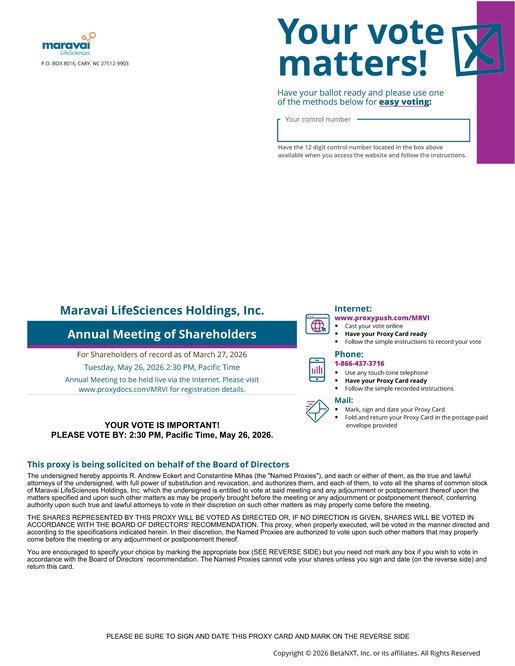
The Board has set a record date of March 27, 2026, for the Annual Meeting. Only shareholders that owned Maravai Class A common stock or Class B common stock at the close of business on that date are entitled to notice of, and may vote at, the meeting or any postponement or adjournment of the meeting. A list of Maravai’s shareholders of record will be available for examination by any shareholder for any purpose relevant to the meeting during ordinary business hours for at least ten days prior to May 26, 2026, at our corporate headquarters located at 10770 Wateridge Circle Suite 200, San Diego, California 92121, and on the date of the meeting, on the virtual platform for the Annual Meeting. Your vote is important. Whether or not you plan to attend the Annual Meeting, we urge you to vote your shares as soon as possible. You may vote by proxy over the Internet, by telephone, or by mail by following the instructions on the proxy card or voting instruction form you receive. Voting by proxy will ensure your representation at the Annual Meeting regardless of whether you attend.
Sincerely,
R. Andrew Eckert
Chair, Board of Directors
NOTICE OF 2026 ANNUAL MEETING OF SHAREHOLDERS
The 2026 Annual Meeting of Shareholders (“Annual Meeting”) of Maravai LifeSciences Holdings, Inc. (“Maravai” or the “Company”) will be held virtually (please visit www.proxydocs.com/MRVI for virtual meeting registration details) on Tuesday, May 26, 2026, at 2:30 p.m. Pacific Time for the following purposes:
1.to elect the three nominees identified in the accompanying proxy statement to the Board of Directors;
2.to ratify the appointment of Deloitte & Touche LLP as Maravai’s independent registered public accounting firm for the year ending December 31, 2026;
3.to approve, on a non-binding advisory basis, the compensation of Maravai’s named executive officers, as disclosed in the accompanying proxy statement; and
4.to transact other business as may properly come before the meeting or any postponement or adjournment of the meeting.
A list of shareholders entitled to vote at the meeting will be available for examination by any shareholder for any purpose relevant to the meeting during ordinary business hours for at least ten days prior to May 26, 2026, at 10770 Wateridge Circle Suite 200, San Diego, California 92121, and on the day of the meeting, on the virtual platform for the Annual Meeting.
The proxy statement and the enclosed proxy card or voting instruction form are first being mailed to the Company’s shareholders of record on or about April 24, 2026.
By Order of the Board of Directors
Kurt Oreshack
General Counsel and Secretary
Important Notice Regarding the Availability of Proxy Materials for the Annual Meeting of Shareholders to Be Held on May 26, 2026: The notice of meeting, the proxy statement and our 2025 annual report are available free of charge at www.proxydocs.com/MRVI.
TABLE OF CONTENTS
COMMONLY ASKED QUESTIONS AND ANSWERS ABOUT THE ANNUAL MEETING
Q: Why did I receive these proxy materials?
The Board of Directors (the “Board”) is soliciting your proxy to vote at the 2026 Annual Meeting of Shareholders (or at any postponement or adjournment thereof) (“Annual Meeting”) of Maravai LifeSciences Holdings, Inc. (“Maravai,” the “Company,” “we,” “us” or “our”). Holders of shares of our Class A common stock, par value $0.01 per share (“Class A common stock”), or our Class B common stock, par value $0.01 per share (“Class B common stock” and, together with the Class A common stock, the “common stock”), as of the record date, March 27, 2026 (the “Record Date”), are entitled to notice of and to vote at the Annual Meeting. You should review this entire proxy statement carefully as it gives important information about the proposals that will be voted on at the Annual Meeting, as well as other important information about Maravai.
Householding. The Securities and Exchange Commission’s (“SEC”) rules permit us to send a single set of proxy materials to shareholders with multiple accounts registered with the same tax identification number or which share the same last name and household mailing address, unless we received contrary instructions from the impacted shareholders prior to the mailing date. This procedure is referred to as “householding.” Each registered shareholder will, however, continue to receive a separate proxy card. We agree to deliver promptly, upon written or oral request, a separate copy of the proxy materials to any shareholder to which a single copy of those documents was delivered. If you prefer to receive separate copies of the annual meeting materials, you may write or call us at the following address or phone number, and we will promptly deliver them.
Maravai LifeSciences Holdings, Inc.
10770 Wateridge Circle Suite 200
San Diego, California 92121
c/o General Counsel and Secretary
Phone: (858) 988-5919
A number of banks and brokers have also instituted householding. They will have their own procedures for shareholders who wish to receive individual copies of the proxy materials instead of a combined mailing. If you are a beneficial shareholder and hold your shares in “street name,” please contact your bank or broker regarding combined mailings.
Q: Who will be entitled to vote?
Shareholders who own shares of our Class A common stock or Class B common stock as of the Record Date are entitled to vote at the Annual Meeting. As of the Record Date, Maravai had 147,496,090 shares of Class A common stock and 110,684,080 shares of Class B common stock outstanding. Holders of shares of Class A common stock and holders of shares of Class B common stock are each entitled to one vote per share, voting together as a single class on all matters to be considered at the Annual Meeting. Cumulative voting is not permitted with respect to the election of directors or any other matter to be considered at the Annual Meeting.
Q: What will I be voting on?
You will be voting on:
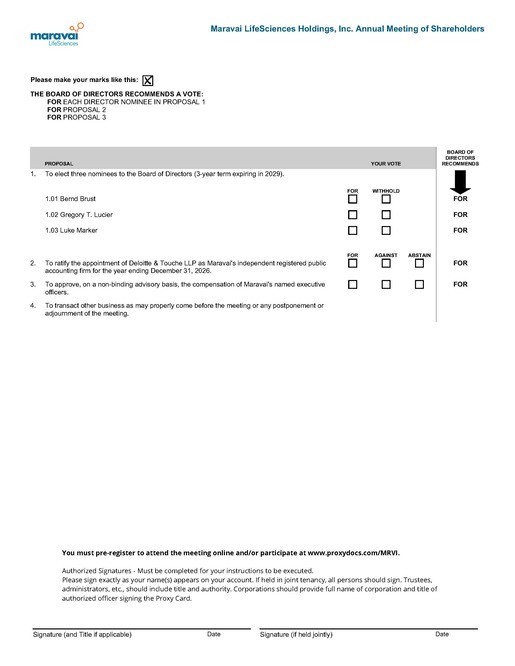
1.the election of each of Bernd Brust, Gregory T. Lucier and Luke Marker to serve on the Board until our 2029 Annual Meeting of Shareholders and until their respective successors are duly elected and qualified;
2.the ratification of the appointment of Deloitte & Touche LLP as Maravai’s independent registered public accounting firm for the year ending December 31, 2026;
3.the approval, on a non-binding advisory basis, of the compensation of our named executive officers, as disclosed in this proxy statement; and
4.any other business as may properly come before the meeting or any postponement or adjournment thereof.
Q: How does the Board recommend I vote on these matters?
The Board recommends you vote:
1.FOR the election of each of Bernd Brust, Gregory T. Lucier and Luke Marker to the Board;
2.FOR the ratification of the appointment of Deloitte & Touche LLP as our independent registered public accounting firm for the year ending December 31, 2026; and
3.FOR the approval, on a non-binding advisory basis, of the compensation of our named executive officers, as disclosed in this proxy statement.
Q: How do I cast my vote?
Registered Shareholders. If you hold shares registered with our transfer agent in your own name, you are a registered shareholder. Whether or not you plan to attend the Annual Meeting, we urge you to vote your shares as soon as possible to ensure your representation at the Annual Meeting. You may still attend the Annual Meeting and vote your shares electronically during the Annual Meeting even if you have already voted by another method.
You can vote by proxy before the Annual Meeting in the following ways:
1.over the Internet at www.proxypush.com/MRVI;
2.by phone by calling 1-866-437-3716; or
3.by completing, signing and returning a proxy card.
Proxies submitted over the Internet, by telephone or by mail must be received prior to the commencement of the Annual Meeting at 2:30 p.m. Pacific Time on May 26, 2026.
To vote during the Annual Meeting, you must register in advance of the meeting at www.proxydocs.com/MRVI. You will need your unique control number included on your proxy card. Upon completing your registration, you will receive further instructions via email, including information about your unique link that will allow you to access the Annual Meeting and to vote during the Annual Meeting. Please be sure to follow the subsequent instructions that will be delivered to you via email. Only one person will be able to log in with that unique control number at any time.
Beneficial Shareholders. If you hold your shares through a bank, broker, trustee or other nominee in “street” name, you are a beneficial shareholder, and you will receive a voting instruction form from your broker, bank or other nominee seeking instructions from you on how to vote the shares you hold as a beneficial shareholder. To vote during the meeting, you must first obtain a legal proxy from your bank, broker or other nominee and deliver that legal proxy to our Corporate Secretary sufficiently in advance of the Annual Meeting, as well as follow the instructions you receive via email after registering to attend the Annual Meeting online.
Q: Can I access the proxy materials electronically?
Yes. Your proxy card or voting instruction form will contain instructions on how to:
1.view our proxy materials for the Annual Meeting on the Internet; and
2.instruct us to send our future proxy materials to you electronically by e-mail.
Our proxy materials are also available at www.proxydocs.com/MRVI.
Instead of receiving future copies of our proxy statement and annual reports by mail, shareholders of record and most beneficial owners can elect to receive an email that will provide an electronic link to these documents. Your election to receive future proxy materials by email will remain in effect until you revoke it.
Q: How may I change or revoke my proxy?
Registered Shareholders. Registered shareholders may change a properly executed proxy at any time before its exercise at the Annual Meeting by:
1.delivering written notice of revocation to our Corporate Secretary at 10770 Wateridge Circle Suite 200, San Diego, California 92121;
2.voting electronically during the Annual Meeting; or
3.submitting another later dated proxy (including a proxy over the Internet, by telephone or by mail which is received prior to the commencement of the Annual Meeting).
Beneficial Shareholders. Beneficial shareholders should contact their broker, trustee or nominee for instructions on how to change their vote.
Q: How can I attend the Annual Meeting?
The Annual Meeting is being held as a virtual only meeting.
Registered Shareholders. If you are a registered shareholder as of the Record Date, you may attend, vote and ask questions virtually at the meeting by registering in advance of the meeting at www.proxydocs.com/MRVI using your unique control number included on your proxy card that accompanies your proxy materials. Upon completing your registration, you will receive further instructions via email, including information about your unique link that will allow you to attend the Annual Meeting and to vote and submit questions during the Annual Meeting.
Beneficial Shareholders. If you are a beneficial shareholder holding your shares through a bank, broker or other nominee in “street name” as of the Record Date, you may gain access to the meeting, including for the purpose of asking questions virtually at the meeting, by registering in advance at www.proxydocs.com/MRVI using the control number found on the voting instruction card provided by your broker, bank or other nominee. In order to vote your shares electronically at the Annual Meeting, in addition to registering in advance, you will also need to obtain a valid legal proxy from your bank, broker or other nominee reflecting the number of shares of our Class A common stock or Class B common stock you held as of the close of business on the Record Date and e-mail the legal proxy to dsmsupport@betanxt.com with the subject line “Maravai Legal Proxy” by 12:00 p.m., Pacific Time, on May 25, 2026. If you do not plan to vote your shares electronically at the meeting, you may vote your shares by following the voting instructions provided by your bank, broker or other nominee.
Online access to the audio webcast of the Annual Meeting will begin at approximately 2:15 p.m., Pacific Time, on May 26, 2026, pursuant to the unique access instructions you receive following your advance registration at www.proxydocs.com/MRVI. If you have questions during the live audio webcast of the Annual Meeting, you may type them into the dialog box provided at any point during the meeting (until the floor is closed to questions). Shareholder questions or comments are welcome, but we will only answer questions pertinent to the matters being voted upon at the Annual Meeting, subject to time constraints. Questions regarding personal matters and statements of advocacy are not pertinent to Annual Meeting matters and therefore will not be addressed. Questions or comments that are substantially similar may be grouped and answered together to avoid repetition.
Only shareholders as of the Record Date that have registered to attend the meeting may listen to the Annual Meeting and ask questions at the meeting.
An audio replay of the Annual Meeting will be available at https://investors.maravai.com shortly after the completion of the meeting.
Q: What if I run into technical issues while trying to access the Annual Meeting?
The virtual meeting platform is supported across browsers and devices running the most updated version of applicable software and plug-ins. Participants should give themselves plenty of time to log in and ensure they have a strong internet connection, and they can hear streaming audio prior to the start of the meeting. Each participant that has registered to attend the meeting will receive a reminder email at approximately 1:30 p.m., Pacific Time, on the day of the meeting, which is one hour prior to the meeting start time. The reminder email will include an FAQ link where you will find contact
information for the Mediant Help Desk. The Mediant Help Desk will be available starting at 1:30 p.m., Pacific Time, until the end of the meeting.
Q: Why is the Annual Meeting virtual only?
We successfully held virtual only annual meetings in past years and believe that this meeting format provides ease of access, real-time communication, and cost savings for our shareholders and the Company. Hosting a virtual meeting makes it easy for our shareholders to attend and participate in the Annual Meeting from any location around the world and provides those of our shareholders who would otherwise not be able to attend the Annual Meeting the opportunity to do so.
Q: What is the voting requirement to approve each of the proposals, and how are the votes counted?
PROPOSAL 1—ELECTION OF DIRECTORS
A plurality of the votes cast by the shares of our common stock present in person or represented by proxy at the meeting and entitled to vote thereon is required to elect each nominee named herein. This means that the three nominees receiving the highest number of “FOR” votes cast at the Annual Meeting will be elected, even if those votes do not constitute a majority of the votes cast. Votes that are “WITHHELD” with respect to one or more nominees will result in the respective nominee receiving fewer votes, but they will not count as votes against a nominee and will have no effect on the outcome of the election of those nominees because directors are elected by a plurality of the votes cast at the Annual Meeting.
If you are a beneficial (or “street name”) shareholder, your bank or broker is not permitted to vote your shares on this proposal if voting instructions are not received from you (this is commonly referred to as a “broker non-vote”). Broker non-votes are not considered votes cast and, therefore, will not impact the election of the director nominees.
PROPOSAL 2—RATIFICATION OF THE APPOINTMENT OF THE INDEPENDENT REGISTERED ACCOUNTING FIRM
The affirmative vote of a majority of the voting power of the shares of our common stock present or represented by proxy at the meeting and entitled to vote thereon is required to approve the ratification of Deloitte & Touche LLP as our independent registered accounting firm for the fiscal year ending December 31, 2026. Abstentions will be counted as present and entitled to vote on this proposal and will therefore have the same effect of a vote "AGAINST" this proposal. Since this is a “routine” matter (as described below), we do not expect there will be any broker non-votes with respect to this proposal.
PROPOSAL 3—ADVISORY VOTE ON THE COMPENSATION OF OUR NAMED EXECUTIVE OFFICERS
The affirmative vote of a majority of the voting power of the shares of our common stock present or represented by proxy at the meeting and entitled to vote thereon is required to approve, on a non-binding advisory basis, the compensation of our named executive officers as disclosed in this proxy statement (commonly known as a “say-on-pay” proposal). Abstentions will be counted as present and entitled to vote on this proposal and will therefore have the same effect as a vote "AGAINST" this proposal. The say-on-pay proposal is not considered a “routine” matter, and therefore, if you are a beneficial (or “street name”) shareholder and your bank, broker or other nominee does not receive instructions from you, they may not vote your shares on your behalf (resulting in a broker non-vote). Broker non-votes are not considered a vote for or against this proposal and, therefore, will have no effect on the approval of this proposal.
Q: When will the results of the vote be announced?
The preliminary voting results will be announced at the end of the Annual Meeting. The final voting results will be published in a Current Report on Form 8-K filed with the SEC within four business days of the Annual Meeting.
Q: What is the deadline for submitting a shareholder proposal or director nomination for the 2027 Annual Meeting?
Shareholder proposals pursuant to SEC Rule 14a-8 for inclusion in Maravai’s proxy statement and form of proxy for our 2027 Annual Meeting of Shareholders must be received by the Corporate Secretary at our principal executive offices at 10770 Wateridge Circle Suite 200, San Diego, California 92121, no later than December 25, 2026.
Shareholders wishing to make a director nomination or submit a proposal at our 2027 Annual Meeting of Shareholders (but not include it in Maravai’s proxy materials for such meeting) must deliver written notice of such nomination or proposal to the Corporate Secretary at Maravai’s principal executive offices no later than the close of business on February 25, 2027, and not earlier than the close of business on January 26, 2027, assuming the date of our 2027 Annual Meeting of Shareholders is no more than 30 days before or after the anniversary of this year’s Annual Meeting. If that is not the case, then such written notice must be delivered by the later of the tenth day following the day on which Maravai publicly releases the date of our 2027 Annual Meeting of Shareholders or the date which is ninety days prior to the date of such meeting. Any such nomination or proposal must also comply with the requirements specified in Maravai’s Amended and Restated Bylaws (“Bylaws”).
In addition to satisfying the requirements under our Bylaws, to comply with the universal proxy rules, shareholders who intend to solicit proxies in support of director nominees, other than Maravai’s nominees, must provide written notice that sets forth all of the information required by Rule 14a-19 under the Securities Exchange Act of 1934, as amended (the “Exchange Act”), which written notice must be postmarked or transmitted electronically to the Corporate Secretary at our principal executive offices at 10770 Wateridge Circle Suite 200, San Diego, California 92121, no later than March 27, 2027. However, if the date of our 2027 Annual Meeting of Shareholders is changed by more than 30 days from May 26, 2027, then written notice must be provided by the later of the 60th day prior to the date of our 2027 Annual Meeting of Shareholders and the 10th day following the day on which public announcement of the date of our 2027 Annual Meeting of Shareholders is first made by us.
Q: If I am a beneficial shareholder and hold my shares in “street name,” how will my shares be voted if I don’t provide voting instructions?
Current New York Stock Exchange rules allow brokers to vote shares on certain “routine” matters for which their customers do not provide voting instructions. If you are a beneficial shareholder and own shares in “street name” through a broker, bank, or other nominee, the ratification of the appointment of Deloitte & Touche LLP as our independent registered public accounting firm for the year ending December 31, 2026 (Proposal 2) is considered a “routine” matter on which your broker may use its discretion to vote your shares without your instructions. The election of directors (Proposal 1) and the advisory vote on executive compensation (Proposal 3) are not routine proposals; therefore, your broker will be unable to vote your shares on these proposals if you do not instruct your broker how to vote, which is referred to as a “broker non-vote.” Broker non-votes will have no effect on the outcome of the election of the director nominees or the advisory vote on executive compensation.
BOARD OF DIRECTORS AND CORPORATE GOVERNANCE
Board Structure and Composition
Our business and affairs are managed under the direction of the Board. Our certificate of incorporation (our “Certificate”) provides that the authorized number of directors may be changed only by resolution of the Board. Our Certificate also provides that the Board will be divided into three classes of directors, with the classes as nearly equal in number as possible. At each annual meeting of shareholders, a class of directors will be elected for a three-year term to succeed the class whose term is then expiring. Since our 2025 annual meeting, the size of our Board has been reduced from eleven to eight directors.
The following table sets forth the director class, name, age as of March 27, 2026, and other information for each member of the Board:
| | | | | | | | | | | | | | | | | | | | | | | | | | | | | | | | | | | | | | |
| Name | | Class | | Age | | Position | | Director Since | | Current Term Expires | | Expiration of Term For Which Nominated |
Bernd Brust | | III | | 59 | | Director and CEO | | 2025 | | 2026 | | 2029 |
Gregory T. Lucier | | III | | 61 | | Director | | 2020 | | 2026 | | 2029 |
Luke Marker | | III | | 41 | | Director | | 2020 | | 2026 | | 2029 |
Susannah Gray | | I | | 65 | | Director | | 2020 | | 2027 | | |
R. Andrew Eckert | | I | | 64 | | Chair of the Board | | 2024 | | 2027 | | |
Constantine Mihas | | I | | 59 | | Director | | 2020 | | 2027 | | |
Sean Cunningham | | II | | 50 | | Director | | 2020 | | 2028 | | |
John DeFord, PhD | | II | | 64 | | Director | | 2023 | | 2028 | | |
We believe that in order for the Board to effectively guide us to long-term sustainable, dependable performance, it should be comprised of individuals with sophistication and experience in the many disciplines that impact our business. In order to best serve our shareholders, we seek to have a Board, as a whole, that is competent in key corporate disciplines, including accounting and financial acumen, business judgment, crisis management, governance, leadership, people management, risk management, social responsibility and reputational issues, strategy and strategic planning. Additionally, we desire that the Board have specific knowledge related to our industry.
The Nominating, Governance and Risk Committee believes that all directors must, at a minimum, meet the criteria set forth in the Company’s Code of Ethics and its Corporate Governance Guidelines, which specify, among other things, that the Nominating, Governance and Risk Committee will consider criteria such as independence, skills, and experience in the context of the needs of the Board. When considering the selection of director nominees, the Nominating, Governance and Risk Committee considers individuals with a range of backgrounds, tenure, skills and experience, among other factors, that, when considered as a group, provide a variety of valuable viewpoints to allow the Board to best fulfill its responsibilities to the long-term interests of our shareholders. Consistent with this philosophy, in addition to the factors described below, the Nominating, Governance and Risk Committee considers nominees who have the variety of skill sets, experiences and personal backgrounds that will allow our directors to provide the diversity of thought that is critical to the Board’s decision-making and oversight process. The Nominating, Governance and Risk Committee also will consider a combination of factors for each director, including (a) the nominee’s ability to represent all shareholders without a conflict of interest, (b) the nominee’s ability to work in and promote a productive environment, (c) whether the nominee has sufficient time and willingness to fulfill the substantial duties and responsibilities of a director, (d) whether the nominee has demonstrated the high level of character, ethics and integrity expected by the Company, (e) whether the nominee possesses the broad professional and leadership experience and skills necessary to effectively respond to the complex issues encountered by a publicly-traded company, (f) the nominee’s ability to apply sound and independent business judgment and (g) differences in background, qualifications and personal characteristics.
The Nominating, Governance and Risk Committee has determined that all of our directors meet the criteria and qualifications set forth in the Company’s Code of Ethics and its Corporate Governance Guidelines and the criteria set forth above for director nominees. Moreover, each director possesses the following critical personal qualities and attributes that we believe are essential for the proper functioning of the Board to allow it to fulfill its duties for our shareholders: accountability, ethical leadership, governance, integrity, risk management, and sound business judgment. In addition, our directors have the confidence to assess and challenge the way things are done and recommend alternative solutions, a keen
awareness of our business and social realities of the environment in which we operate, the independence and high-performance standards necessary to fulfill the Board’s oversight function, and the humility, professional maturity, and style to interface openly and constructively with other directors. Finally, the director biographies below include a non-exclusive list of other key experiences and qualifications that further qualify the individual to serve on the Board. We believe these collective qualities, skills, experiences and attributes are essential to the Board’s ability to exercise its oversight function for Maravai and its shareholders and to guide us to long-term sustainable, dependable performance.
Subject to any earlier resignation or removal in accordance with the terms of our Certificate, Bylaws or the Director Nomination Agreement (as defined and discussed below) with Maravai Life Sciences Holdings, LLC (“MLSH 1”), Maravai Life Sciences Holdings 2, LLC (“MLSH 2”), GTCR Fund XI/C LP, GTCR Fund XI/B LP, GTCR Co-Invest XI LP, GTCR Partners XI/A&C LP, GTCR Partners XI/B LP and GTCR Investment XI LLC (collectively, “GTCR”), our Class III directors will be elected at this Annual Meeting to serve until our 2029 Annual Meeting of Shareholders, our Class I directors will serve until our 2027 Annual Meeting of Shareholders, and our Class II directors will serve until our 2028 Annual Meeting of Shareholders. In addition, our Certificate provides that our directors may be removed with or without cause by the affirmative vote of at least a majority of the voting power of our outstanding shares of stock entitled to vote generally in an election of directors, voting together as a single class, for so long as GTCR beneficially owns 40% or more, in the aggregate, of the total number of shares of our common stock then outstanding (“Voting Stock”). If GTCR no longer beneficially owns in the aggregate (directly or indirectly) 40% or more of our Voting Stock, then our directors may be removed only for cause upon the affirmative vote of at least 66 2⁄3% of the voting power of the outstanding shares of Voting Stock, voting together as a single class.
Director Nomination Agreement
In connection with our initial public offering (our “IPO”), we entered into a director nomination agreement (as further amended and restated, the “Director Nomination Agreement”) with MLSH 1, MLSH 2 and GTCR. The Director Nomination Agreement provides GTCR the right to nominate to the Board a number of designees equal to at least: (i) 100% of the total number of directors comprising the Board, so long as GTCR beneficially owns shares of Class A common stock and Class B common stock representing at least 40% of the total amount of shares of Class A common stock and Class B common stock GTCR owned as of the date of the IPO, (ii) 40% of the total number of directors, in the event that GTCR beneficially owns shares of Class A common stock and Class B common stock representing at least 30% but less than 40% of the total amount of shares of Class A common stock and Class B common stock GTCR owned as of the date of the IPO, (iii) 30% of the total number of directors, in the event that GTCR beneficially owns shares of Class A common stock and Class B common stock representing at least 20% but less than 30% of the total amount of shares of Class A common stock and Class B common stock GTCR owned as of the date of the IPO, (iv) 20% of the total number of directors, in the event that GTCR beneficially owns shares of Class A common stock and Class B common stock representing at least 10% but less than 20% of the total amount of shares of Class A common stock and Class B common stock GTCR owned as of the date of the IPO and (v) one director, in the event that GTCR beneficially owns shares of Class A common stock and Class B common stock representing at least 5% of the total amount of shares of Class A common stock and Class B common stock GTCR owned as of the date of the IPO. In each case, GTCR’s nominees must comply with applicable law and satisfy any applicable stock exchange rules. In addition, GTCR shall be entitled to designate the replacement for any of its Board designees whose Board service terminates prior to the end of the director’s term, regardless of GTCR’s beneficial ownership at that time. GTCR shall also have the right to have its designees participate on committees of the Board proportionate to its voting power, subject to compliance with applicable law and stock exchange rules regarding the independence of such committees. The Director Nomination Agreement also prohibits us from increasing or decreasing the size of the Board without the prior written consent of GTCR. The Director Nomination Agreement will automatically terminate at such time as GTCR beneficially owns less than 5% of the shares of Class A and Class B common stock it beneficially owned as of the date of the IPO.
One of the three director nominees for election at the Annual Meeting (Mr. Marker) was nominated by GTCR pursuant to the Director Nomination Agreement.
Shareholder Recommendations for Director Nominees
Subject to the rights of GTCR under the Director Nomination Agreement, the Nominating, Governance and Risk Committee will evaluate candidates for director recommended by our shareholders in the same manner as director candidates identified through other means based on the criteria and process outlined in our Corporate Governance Guidelines. Shareholders who wish to identify director candidates for consideration by the Nominating and Corporate Governance Committee may write to 10770 Wateridge Circle Suite 200, San Diego, California 92121, Attn: General
Counsel and Secretary, and any candidates so identified will be forwarded to the Chair of the Nominating, Governance and Risk Committee for consideration.
Shareholders may also nominate directors for election to the Board. In order to nominate a candidate for director at our 2027 Annual Meeting of Shareholders, nominations must be submitted in writing to our Corporate Secretary at our principal executive offices at 10770 Wateridge Circle Suite 200, San Diego, California 92121, and must be received no later than the close of business on February 25, 2027 and not earlier than the close of business on January 26, 2027. Nominations for director must also satisfy the other procedural requirements specified in our Bylaws. In addition to satisfying the requirements under our Bylaws, to comply with the universal proxy rules, shareholders who intend to solicit proxies in support of director nominees, other than the Company’s nominees, must provide written notice that sets forth all of the information required by Rule 14a-19 under the Exchange Act, which written notice must be postmarked or transmitted electronically to the Corporate Secretary at our principal executive offices at 10770 Wateridge Circle Suite 200, San Diego, California 92121, no later than March 27, 2027. However, if the date of our 2026 Annual Meeting of Shareholders is changed by more than 30 days from May 26, 2027, then written notice must be provided by the later of the 60th day prior to the date of our 2027 Annual Meeting of Shareholders and the 10th day following the day on which public announcement of the date of our 2027 Annual Meeting of Shareholders is first made by us.
When filling a vacancy on the Board, the Nominating, Governance and Risk Committee identifies the desired skills and experience of a new director and nominates individuals who it believes can strengthen the Board’s capabilities and further diversify the collective experience represented by the then-current directors. The Nominating, Governance and Risk Committee may engage third parties to assist in the search and provide recommendations. Also, then-current directors may be asked to recommend candidates. All candidates for director are evaluated based on the criteria and process outlined in our Corporate Governance Guidelines and the Nominating, Governance and Risk Committee charter, and the same criteria and process are used to evaluate all candidates, including candidates that may be recommended by our shareholders.
PROPOSAL 1 – ELECTION OF DIRECTORS
Based upon the recommendation of the Nominating, Governance and Risk Committee, the Board has nominated the following three directors to be re-elected to the Board at the Annual Meeting: Bernd Brust, Gregory T. Lucier, and Luke Marker.
If elected at the Annual Meeting, the nominees will serve for three-year terms expiring at our 2029 Annual Meeting of Shareholders and until their respective successors are duly elected and qualified, or until his or her earlier death, resignation or removal. Certain biographical information for each of the nominees is set forth below. Also set forth therein is a description of the specific experience, qualifications, attributes and skills of each nominee that were considered by the Nominating, Governance and Risk Committee, in the context of the needs of the Board as a whole, in determining that these individuals were qualified to serve on the Board.
Each nominee has consented to stand for re-election and has agreed to serve if elected. We currently have no reason to believe that any of the nominees would be unable or unwilling to serve if elected. However, if before the Annual Meeting, any nominee becomes unable to serve, or chooses not to serve, the Board may nominate a substitute. If that happens, the persons named as proxies on the proxy card will vote for the substitute. Alternatively, the Board may either let the vacancy stay unfilled until an appropriate candidate is identified or reduce the size of the Board to eliminate the vacancy.
The Board unanimously recommends that you vote “FOR” each of the director nominees below.
Proxies solicited on behalf of the Board will be voted “FOR” the election of each of the three nominees, unless your proxy card is marked otherwise (if you are a registered shareholder) or you have provided a different instruction to your bank or broker (if you are a beneficial or “street name” shareholder).
Vote Required
Under our Bylaws, the election of the three director nominees at the Annual Meeting requires a plurality of the votes cast by holders of shares of our common stock present in person or represented by proxy and entitled to vote on the election of directors. In an uncontested election of directors, this means that each director nominee will be elected if he or she receives at least one “FOR” vote. Failure to vote by proxy or electronically at the virtual Annual Meeting and “WITHHOLD” votes will result in a respective nominee having fewer votes but will have no effect on the outcome of the election because a plurality of the votes cast is required for the election of the director nominee. Cumulative voting is not permitted in the election of directors.
Director Nominees to Serve for Three-Year Terms Expiring at the 2029 Annual Meeting of Shareholders.
Bernd Brust has served on the Board and as our Chief Executive Officer since June 2025. Prior to joining Maravai, Mr. Brust served as Executive Chairman, from 2021 to 2025, and as Chief Executive Officer, from 2014 to 2021, of Antylia Scientific (f/k/a Cole-Parmer Instrument Company), a life sciences company. Mr. Brust previously served as Chief Executive Officer of Qualicaps, Inc., a pharmaceutical encapsulation company, from 2011 to 2013. Before that, Mr. Brust held senior leadership roles at Life Technologies, Inc. ("Life Technologies") as well as executive positions at Invitrogen Corporation (a predecessor of Life Technologies) and GE Medical Systems. Mr. Brust holds a degree in engineering from the Middelbare Technische School. Mr. Brust is a valuable member of the Board due to his experience as our Chief Executive Officer and his executive experience at other life science companies.
Gregory T. Lucier has served on the Board since our IPO in November 2020 and on our Nominating, Governance and Risk Committee since October 2025, and has served as a member of MLSH 1’s board since January 2020. Mr. Lucier, a 30-year veteran of the healthcare industry, currently serves as the Executive Chairman and Chief Executive Officer of Corza Health, Inc. (“Corza Health”), a life sciences company. Mr. Lucier previously served as Corza Health’s Executive Chairman from February 2021 to December 2024 and served as the Chief Executive Officer of Corza Health from April 2019 until January 2021. Prior to Corza Health, Mr. Lucier was Chief Executive Officer of NuVasive, Inc., a medical device company (“NuVasive”), from June 2015 to November 2018, and served as Chairman of the Board for NuVasive from March 2015 until May 2021. Prior to NuVasive, from 2003 to 2014, Mr. Lucier served as Chair and Chief Executive Officer of Life Technologies. Mr. Lucier’s early career included roles as a corporate officer of General Electric Company and as an executive at GE Medical Systems Information Technologies, Inc., a healthcare company. Mr. Lucier serves as a director of Dentsply Sirona Inc., a global provider of professional dental products and technologies, and Avantor, Inc., a
biotech company, and served as director of PhenomeX (formerly Berkeley Lights) from December 2021 to September 2023, when PhenomeX was acquired by Bruker Corporation and as director of Catalent, Inc., a global pharmaceutical products manufacturer from 2015 until its acquisition by Novo Holdings in 2024. Mr. Lucier holds an MBA from Harvard Business School and a BA in Industrial Engineering from Pennsylvania State University. We determined Mr. Lucier’s extensive experience in the healthcare and medical device industry, in addition to his experience on multiple public and private boards of directors, qualify him to serve as a director on the Board.
Luke Marker has served on the Board since our IPO in November 2020 and has served as a member of MLSH 1’s board since 2016. Mr. Marker joined GTCR in 2009 where he is currently Managing Director. Prior to joining GTCR, he worked in the investment banking division at Lehman Brothers and Barclays Capital. Mr. Marker holds an MBA with distinction from Harvard Business School and a BA in Mathematics and Economics from Kalamazoo College. Mr. Marker also serves as a director of private companies Biocoat, Corza Medical and Regatta Medical. We determined that Mr. Marker’s directorship experience with similar companies and extensive experience in the healthcare, pharmaceutical and life sciences industries qualify him to serve as a director on the Board.
Continuing Directors
Sean Cunningham has served on the Board since our IPO in November 2020 and on our Nominating, Governance and Risk Committee since October 2022, and has served as a member of MLSH 1’s board since March 2016. Mr. Cunningham also serves on the Board of Directors of Sotera Health Company (“Sotera Health”), a healthcare company. Mr. Cunningham joined GTCR in 2001 where he is currently a Managing Director and Head of the Healthcare Group. Mr. Cunningham was previously a consultant with The Boston Consulting Group. Mr. Cunningham holds an MBA from the Wharton School at the University of Pennsylvania as well as a BA and BE in Engineering Sciences from Dartmouth College. We determined that Mr. Cunningham’s directorship experience with similar companies and extensive experience in the healthcare and pharmaceutical industries qualify him to serve as a director on the Board.
John DeFord, PhD, has served on the Board since July 2023 and on our Audit Committee and Compensation and Leadership Development Committee since September 2023. He assumed the role of Chair of our Compensation and Leadership Development Committee in June 2024. Dr. DeFord also serves on the Board of Directors of Nordson Corporation, a precision technology company, and has been proposed to be appointed to Royal Philips Company's supervisory board. Dr. DeFord served as a director of Globus Medical Inc., a medical device company, from September 2023 to March 2026. Dr. DeFord has been the Chairman, Chief Executive Officer and President of Samothrace Medical Innovations, Inc., a medical technology company, since coming out of retirement in March 2022. Dr. DeFord has over 35 years of experience in the healthcare and medical device industries. Dr. DeFord served as Executive Vice President and Chief Technology Officer of Becton, Dickinson and Company (“Becton Dickinson”), a global medical technology company, from June 2018 until he retired from Becton Dickinson in May 2021. Dr. DeFord joined Becton Dickinson in December 2017 in connection with its acquisition of C.R. Bard, Inc. (“Bard”), a medical technology company, where he served as the Senior Vice President of Research and Development for Becton Dickinson’s interventional segment post-acquisition. Prior to the acquisition, Dr. DeFord served in a variety of science and technology roles at Bard since January 2004 and was Senior Vice President of Science, Technology and Clinical Affairs at the time of the acquisition by Becton Dickinson. Prior to joining Bard, Dr. DeFord was Managing Director of Early Stage Partners, a venture capital fund. Prior to joining Early Stage Partners, Dr. DeFord was President and Chief Executive Officer of Cook Incorporated, medical device manufacturer. Dr. DeFord holds a PhD in Electrical/Biomedical Engineering, a MS in Electrical Engineering and a BS in Electrical Engineering from Purdue University. Dr. DeFord is a valuable member of the Board due to his executive experience at medical technology companies and his service as an independent director to other public companies.
R. Andrew Eckert has served on the Board as Chairman since December 2024, and on our Audit Committee and Nominating, Governance, and Risk Committee, where he assumed the role of Chair, since October 2025. Mr. Eckert also currently serves as a director on the Board of Directors of Becton Dickinson, and formerly served as a director of Fortrea Holdings, Inc., a contract research organization, from June 2023 to February 2025, and Varian Medical Systems, Inc., a medical device and software company (“Varian Medical”), where he served as a director from October 2004 to February 2014 and as Chairman of the Board from February 2014 to April 2021, when Varian Medical was acquired by Siemens Healthineers. Mr. Eckert currently serves as a Senior Adviser to Permira I.P Limited, a global private equity firm (“Permira”), and previously served as interim Chief Executive Officer of Lytx, Inc., a telematics company ("Lytx"), from December 2024 to July 2025, where he currently serves as Chairman of the Board. Prior to Permira, Mr. Eckert served as Chief Executive Officer of Zelis Inc., a healthcare payments and cost management business (“Zelis”) from August 2020 until August 2021, and as the President and Chief Executive Officer of Acelity L.P., a global wound care company (“Acelity”), from April 2017 until October 2019, when Acelity was acquired by 3M. Mr. Eckert holds an MBA from the Stanford University Graduate School of Business and a BS in Industrial Engineering from Stanford University. We
determined that Mr. Eckert’s extensive directorship and chairman experience with similar publicly traded companies, and extensive experience as an executive at publicly traded companies in the healthcare and life sciences industries qualify him to serve as Chairman of the Board.
Susannah Gray has served on the Board and as the Chair of our Audit Committee since our IPO in November 2020 and has served on our Compensation and Leadership Development Committee since October 2022. Ms. Gray also currently serves on the Board of Directors of 4D Molecular Therapeutics, Inc., a biotech company, AnaptysBio, Inc., a biotech company, and Theravance BioPharma, Inc., a biopharmaceutical company. Ms. Gray previously served on the Board of Directors of Morphic Holding, Inc. (the parent company of Morphic Therapeutic, Inc.), a biotech company, from April 2021 to August 2024 and Apria, Inc., a healthcare company, from May 2021 to March 2022, when Apria, Inc. was acquired by Owens & Minor, Inc. Ms. Gray served as the Chief Financial Officer of Royalty Pharma Management LLC (“Royalty Pharma”), a buyer of pharmaceutical royalties, from January 2005 to December 2018. Ms. Gray was promoted to Executive Vice President of Finance and Strategy in December 2018 and retired from Royalty Pharma in September 2019. Prior to Royalty Pharma, Ms. Gray served as a managing director and senior analyst covering the healthcare sector of CIBC World Markets’ high yield group from 2002 to 2004, and also previously served in similar roles at Merrill Lynch and Chase Securities (predecessor of J.P. Morgan Securities). Ms. Gray holds an MBA from Columbia University and a BA in Social Studies from Wesleyan University. We determined that Ms. Gray’s extensive executive experience in the pharmaceutical industry, as well as her financial expertise, qualify her to serve as a director on the Board.
Constantine Mihas has served on the Board since our IPO in November 2020 and on our Compensation and Leadership Development Committee since October 2022, and has served as a member MLSH 1’s board since March 2016. Previously, Mr. Mihas served as Chair of the Compensation and Nominating Committee from our IPO in November 2020 until October 2022. Mr. Mihas also serves on the Board of Directors of Sotera Health. Mr. Mihas joined GTCR in 2001 where he is currently Co-CEO and Managing Director. Prior to joining GTCR, Mr. Mihas was Chief Executive Officer and co-founder of Delray Farms, LLC (“Delray Farms”), a specialty food retailer. Prior to Delray Farms, Mr. Mihas was with McKinsey & Company, Inc., a consulting firm. Mr. Mihas holds an MBA with distinction from the Harvard Business School and a BS in Finance and Economics from the University of Illinois, Chicago. We determined that Mr. Mihas’ directorship experience with similar companies, deep business background, and extensive experience in the healthcare, pharmaceutical and life sciences industries qualify him to serve as a director on the Board.
Summary of Director Skills, Experience & Attributes
Our directors, including those who have been nominated for re-election, comprise a group of individuals with various relevant skills, experience and attributes. Provided below is a summary of some of the key characteristics of each of our directors that are relevant to their service on the Board. The summary below is intended as a high-level summary of certain
areas of knowledge, skill and experience that are germane to the Company, and is not an exhaustive list of each director’s skills or contributions to the Board.
| | | | | | | | | | | | | | | | | | | | | | | | | | |
| Skills and Experience | B. Brust | S. Cunningham | J. DeFord, PhD | R. Andrew Eckert | S. Gray | G. Lucier | L. Marker | C. Mihas |
| | | | | | | | |
| Industry Knowledge | ● | ● | ● | ● | ● | ● | ● | ● |
| | | | | | | | |
| | | | | | | | |
| Innovation / Technology | ● | | ● | ● | | ● | | |
| | | | | | | | |
| | | | | | | | |
| International Business | ● | | ● | ● | ● | ● | ● | ● |
| | | | | | | | |
| | | | | | | | |
| Corporate Governance | | ● | ● | ● | ● | ● | ● | ● |
| | | | | | | | |
| | | | | | | | |
| Business Development / Corporate Strategy | ● | ● | ● | ● | ● | ● | ● | ● |
| | | | | | | | |
| | | | | | | | |
| C-Suite / Sr. Executive Leadership | ● | | ● | ● | ● | ● | ● | ● |
| | | | | | | | |
| | | | | | | | |
| Executive Compensation | | | ● | ● | ● | ● | | ● |
| | | | | | | | |
| | | | | | | | |
| Finance & Accounting | | | | ● | ● | ● | | |
| | | | | | | | |
| | | | | | | | |
| Corporate Finance and M&A | ● | ● | ● | ● | ● | ● | ● | ● |
| | | | | | | | |
| | | | | | | | |
| Risk Oversight / Management | ● | ● | ● | ● | ● | ● | ● | ● |
| | | | | | | | |
| | | | | | | | |
| Number of Other Current Public Company Boards | — | 1 | 1 | 1 | 3 | 1 | — | 1 |
| | | | | | | | |
Independence Status
The listing standards of the Nasdaq Global Select Market (“Nasdaq”) require that, subject to specified exceptions, such as those described below under the subsection entitled, “Controlled Company Status,” a majority of the members of the board of directors and each member of a listed company’s audit committee, compensation committee and nominations committee be independent and that audit committee members and compensation committee members also satisfy independence criteria set forth in Rule 10A-3 under the Exchange Act and the Nasdaq listing standards, respectively.
The Board has affirmatively determined that each of Messrs. Eckert and Lucier, Ms. Gray and Drs. DeFord, Hopfield (who served on the Board until October 21, 2025) and Prahalad (who served on the Board until October 21, 2025) qualified, and, as applicable, continues to qualify, as an independent director in accordance with the Nasdaq listing standards. In addition, the Board has determined that each of Dr. DeFord, Mr. Eckert and Ms. Gray meets the heightened independence requirements for audit committee membership as set forth in Rule 10A-3 under the Exchange Act. In making these determinations, the Board considered the relationships (if any) that each non-employee director (and any of his or her family members) had or has with the Company and all other facts and circumstances that the Board deemed relevant, including beneficial ownership of our common stock, and found that none of such directors, nor any of his or her family members, had or has a relationship with the Company, which, in the Board’s opinion, would interfere with his or her exercise of independent judgment in carrying out the responsibility of a director of the Company.
Controlled Company Status
GTCR controls a majority of our outstanding common stock. As a result, we are a “controlled company.” Under Nasdaq rules, a company of which more than 50% of the voting power for the election of directors is held by an individual, group or another company is a “controlled company” and may elect not to comply with certain Nasdaq corporate governance rules. As long as we remain a controlled company, we may rely on these exemptions from time to time standards. Accordingly, you may not have the same protections afforded to shareholders of companies that are subject to all
of Nasdaq’s corporate governance requirements. A summary of Nasdaq’s corporate governance rule exemptions for controlled companies and the extent to which we currently rely on them is set forth below.
| | | | | |
Controlled Companies are Exempt from the Following Nasdaq Rules: | Maravai’s Current Corporate Governance Structure: |
The requirement the board of directors consist of a majority of “independent directors” | We currently rely on the controlled company exemption for this requirement; our Board is not composed of a majority of “independent directors.” |
The requirement that companies have a compensation committee that consist entirely of independent directors | We currently rely on the controlled company exemption for this requirement. While our Compensation and Leadership Development Committee is composed of a majority of independent directors, it does not consist entirely of independent directors. |
The requirement that companies have a nominations committee that consist entirely of independent directors. | We currently rely on the controlled company exemption for this requirement. While our Nominating, Governance and Risk Committee is composed of a majority of independent directors, it does not consist entirely of independent directors. |
Board Meetings and Committees
In 2025, the Board held eight meetings. The Audit Committee held nine meetings, the Compensation and Leadership Development Committee held twelve meetings, and the Nominating, Governance and Risk Committee held two meetings in 2025. Directors are expected to attend the annual meeting of shareholders and all or substantially all of the Board meetings and meetings of committees on which they serve. In 2025, each director attended at least 85% of the meetings of the Board and any of the committees of the Board on which the director served. All of our then-serving directors attended our 2025 Annual Meeting of Shareholders.
The Board has an Audit Committee, a Compensation and Leadership Development Committee and a Nominating, Governance and Risk Committee. The current composition, duties and responsibilities of these committees are as set forth below. In the future, the Board may establish other committees, as it deems appropriate, to assist it with its responsibilities.
| | | | | | | | | | | | | | | | | |
| Board Member | Audit Committee | | Compensation and Leadership Development Committee | | Nominating, Governance and Risk Committee |
Bernd Brust | | | | | |
Sean Cunningham | | | | | X |
| John DeFord, PhD | X | | X (Chair) | | |
| R. Andrew Eckert | X | | | | X (Chair) |
| Susannah Gray | X (Chair) | | X | | |
| Gregory T. Lucier | | | | | X |
| Luke Marker | | | | | |
| Constantine Mihas | | | X | | |
Audit Committee
The Audit Committee is responsible for, among other matters:
1.appointing, approving the compensation of, and assessing the qualifications, performance and independence of our independent registered public accounting firm;
2.pre-approving audit and permissible non-audit services, and the terms of such services, to be provided by our independent registered public accounting firm;
3.discussing on a periodic basis, or as appropriate, with management, our policies, programs and controls with respect to risk assessment and risk management;
4.reviewing and discussing with management and the independent registered public accounting firm our annual and quarterly consolidated financial statements and related disclosures as well as critical accounting policies and practices used by us;
5.reviewing our management’s discussion and analysis of financial condition and results of operations to be included in our annual and quarterly reports to be filed with the SEC;
6.monitoring the rotation of partners of the independent registered public accounting firm on our engagement team in accordance with requirements established by the SEC;
7.reviewing management’s report on its assessment of the effectiveness of internal control over financial reporting and any changes thereto;
8.reviewing the adequacy of our internal control over financial reporting and disclosure controls and procedures;
9.establishing policies and procedures for the receipt and retention, follow-up and resolution of accounting, internal accounting controls or auditing matters, complaints and concerns;
10.recommending, based upon the Audit Committee’s review and discussions with management and the independent registered public accounting firm, whether our audited consolidated financial statements shall be included in our Annual Report on Form 10-K;
11.monitoring our compliance with legal and regulatory requirements as they relate to our consolidated financial statements and accounting matters;
12.preparing the Audit Committee report required by the rules of the SEC to be included in our annual proxy statement;
13.investigating any matters received, and reports to the Board periodically, with respect to ethics issues, complaints and associated investigations;
14.reviewing the Audit Committee charter and the committee’s performance at least annually;
15.reviewing and overseeing all related party transactions for potential conflict of interest situations and approving all such transactions; and
16.reviewing and discussing with management our earnings releases and scripts.
The Board has affirmatively determined that each of Mr. Eckert, Dr. DeFord and Ms. Gray meets the definition of “independent director” for purposes of serving on an Audit Committee under Rule 10A-3 of the Exchange Act and the applicable Nasdaq listing standards. In addition, the Board has determined that Ms. Gray qualifies as an “audit committee financial expert” as such term is defined in Item 407(d)(5) of Regulation S-K ("Regulation S-K") under the Securities Act of 1933, as amended.
The written charter for our Audit Committee is available at our corporate website at investors.maravai.com. The information contained on or accessible through our website is not part of, nor incorporated by reference into, this proxy statement or considered to be part of this document.
Compensation and Leadership Development Committee
The Compensation and Leadership Development Committee is responsible for, among other matters:
1.establishing our overall compensation philosophy goals and objectives relevant to the compensation of our chief executive officer;
2.overseeing the development and implementation of our compensation programs and policies;
3.annually reviewing and approving corporate goals and objectives relevant to the compensation of our chief executive officer and other executive officers;
4.evaluating the performance of our chief executive officer and other executive officers in light of such corporate goals and objectives;
5.recommending for approval to the Board the amount and form of chief executive officer compensation, taking into account the Board’s annual performance evaluation of the chief executive officer, peer group and other factors deemed most relevant, including the results of the most recent shareholder advisory vote on executive compensation;
6.reviewing and approving the compensation of our other executive officers;
7.retaining, terminating and setting fees and retention terms for any compensation consultant, legal counsel or other advisor it deems necessary or appropriate in its own discretion;
8.conducting the independence assessment outlined in Nasdaq rules with respect to any compensation consultant, legal counsel or other advisor retained by the committee;
9.annually reviewing and reassessing the adequacy of the committee charter in its compliance with the listing requirements of the Nasdaq;
10.reviewing and establishing our overall compensation and benefits programs and policies;
11.oversee and administer the Company's equity-based incentive compensation plans, including designating employees to whom awards are to be granted, the amount of the award or equity to be granted and the terms and conditions applicable to each award or grant, subject to the provisions of each plan, and make recommendations to the Board for approval of awards to our chief executive officer under such plans;
12.oversee the Company's non-equity-based incentive compensation plans in which our executive officers participate and administer any such plans to the extent our executive officers participate, including the eligibility of our executive officers to participate in such plans, the terms and conditions applicable to their participation, and the determination of ultimate amounts payable to our executive officers under such plans, and make recommendations to the Board for approval the participation and ultimate amounts payable to our chief executive officer under such plans;
13.consider the results of the most recent say-on-pay vote, if applicable, when reviewing and making recommendations regarding incentive compensation plans;
14.monitoring the effectiveness of non-equity based benefit plan offerings, in particular those pertaining to our executive officers;
15.setting the composition of the peer company group used for market comparison of our executive compensation program;
16.reviewing and making recommendations to the Board with respect to director compensation and benefits;
17.determining stock ownership guidelines for our chief executive officer and other executive officers, and monitoring compliance with such guidelines;
18.reviewing and making recommendations to the Board regarding any adoption or amendment or modification to the Company's “clawback” policy allowing the Company to recoup incentive compensation in compliance with Section 10D of the Exchange Act, the rules promulgated thereunder and the rules of NASDAQ from employees subject to Section 16 of the Exchange Act, and administering and enforcing such “clawback” policy in accordance with its terms;
19.reviewing our incentive compensation arrangements to determine whether they encourage excessive risk-taking, and evaluating our compensation policies and practices that could mitigate any such risk;
20.reviewing and making recommendations to the Board with respect to the frequency with which the Company will conduct advisory votes on executive compensation;
21.reviewing and discussing with management the compensation discussion and analysis and related executive compensation information included in our annual proxy statement or Annual Report on Form 10-K, and producing the committee’s report on executive officer compensation included in our annual proxy statement or Annual Report on Form 10-K;
22.developing and recommending to the Board for its approval a succession plan for our chief executive officer, reviewing such succession plan periodically, developing and evaluating potential candidates for the chief executive officer position, and recommending to the Board any changes to any candidates under such succession plan;
23.advising the Board and our chief executive officer on the development, retention and succession of executive officers; and
24.reviewing our human capital strategy, including key practices related to attracting, developing, and retaining talent, leadership development and succession, and employee engagement and effectiveness, considering how these practices support our business strategy and long-term performance.
The Board has affirmatively determined that each of Ms. Gray and Dr. DeFord meets the definition of “independent director” for purposes of serving on a compensation committee under Rule 10C-1 of the Exchange Act and the applicable Nasdaq listing standards.
The Board has adopted a written charter for the Compensation and Leadership Development Committee, which is available on our corporate website at investors.maravai.com. The information contained on or accessible through our website is not part of, nor is it incorporated by reference into, this proxy statement or considered to be part of this document.
Nominating, Governance and Risk Committee
The Nominating, Governance and Risk Committee is responsible for, among other matters:
1.developing and recommending to the Board for its approval changes to the criteria for the selection of new directors as set forth in our Corporate Governance Guidelines;
2.identifying, recruiting, screening and recommending to the Board candidates for director consistent with the criteria set forth in our Corporate Governance Guidelines;
3.developing and recommending to the Board standards for determining whether a director is independent;
4.reviewing the size of the Board and the Board’s leadership structure and recommending changes to the Board as appropriate;
5.proposing to the Board director candidates to fill any vacancies on the Board;
6.proposing changes to the Board to, or developing as needed, any of the Company’s corporate governance documents or other policies;
7.reviewing and making recommendations to the Board on the size, structure and composition of the committees of the Board;
8.developing an annual evaluation process for the Board and its committees, subject to approval by the Board, and overseeing the conduct of this annual evaluation;
9.reviewing and discussing with management disclosure of the Company’s corporate governance practices and recommending that this disclosure be included in our annual proxy statement or Annual Report on Form 10-K, as applicable;
10.overseeing our major risk exposures, including cybersecurity and other information security matters, and reviewing the process by which management assesses risk and the steps management has taken to monitor and mitigate such exposures;
11.receiving and reviewing reports from management on risk management matters as necessary or appropriate from time to time; and
12.reviewing disclosures regarding risk oversight contained in our annual proxy statement or Annual Report on Form 10-K.
The Board has adopted a written charter for the Nominating, Governance and Risk Committee, which is available on our corporate website at investors.maravai.com. The information contained on or accessible through our website is not part of, nor is it incorporated by reference into, this proxy statement or considered to be part of this document.
Board Leadership Structure
The Board believes that an independent Chairman and the mix of experienced independent directors, as well as the GTCR-affiliated directors, that currently comprise the Board, together with the structure and composition of the Board committees, provides strong overall risk oversight and strategic direction for the Company, benefitting Maravai and all of its shareholders.
Board Mix
The Board has an effective mix of independent and management directors. The Board includes four independent directors, our Chief Executive Officer ("CEO"), and three representatives affiliated with our controlling shareholder, GTCR.
Chair of the Board
With respect to the roles of Chairman of the Board and CEO, our Corporate Governance Guidelines provide that the roles may be at times separated or at times combined, giving the Board discretion in combining or separating these positions as it deems appropriate in light of prevailing circumstances. Currently, the roles of CEO and Chairman of the Board are held by separate persons, and the Chairman of the Board, Mr. Eckert, is an independent director. The Chairman’s responsibilities include, but are not limited to, presiding over all meetings of the Board at which members of management are not present, including any executive sessions of independent directors, reviewing Board meeting schedules and agendas and acting as a liaison between the independent directors and the CEO. The Board may make changes to its leadership structure in the future as it deems appropriate and in the best interests of the Company and its shareholders, as part of the Company’s succession planning process or otherwise, taking into account the Board’s and Company’s needs and the composition of the Board at such time.
Management Succession
The Compensation and Leadership Development Committee makes a report to the Board on succession planning at least once a year. The entire Board works with the Compensation and Leadership Development Committee to evaluate potential successors to the CEO and other executive officers. The CEO and such other officers also make available to the Compensation and Leadership Development Committee their recommendations and evaluations of potential successors, along with a review of any development plans recommended for such individuals.
Risk Oversight
Our Nominating, Governance and Risk Committee oversees an enterprise-wide approach to risk management, designed to support the achievement of organizational objectives, to improve long-term organizational performance, and to enhance shareholder value. A fundamental part of risk management is not only understanding the most significant risks a company faces and what steps management is taking to manage those risks but also understanding what level of risk is appropriate for a given company. The involvement of our Nominating, Governance and Risk Committee in reviewing our business is an integral aspect of its assessment of the Company’s risk profile and also its determination of what constitutes an appropriate level of risk.
Our Nominating, Governance and Risk Committee oversees our principal operational, business, compliance, information security and ethics risks, including the appropriateness of reporting lines of authority, communications, systems and controls based on our structure, size and scope of operations, and the steps our management has taken to monitor and control these exposures, including guidelines and policies to govern the process by which risk assessment and management is undertaken. In particular, our Nominating, Governance and Risk Committee is charged with overseeing our management’s efforts to identify, evaluate and mitigate major risks related to cybersecurity, data protection controls, business continuity/disaster recovery systems and other information security matters, including the prevention and timely detection of the effects of cybersecurity threats or incidents to Maravai. Our Nominating, Governance and Risk Committee also monitors compliance with legal and regulatory requirements and management provides our Nominating, Governance and Risk Committee periodic reports on our compliance programs. In addition, our Nominating, Governance and Risk Committee oversees our major corporate governance risks.
While our Nominating, Governance and Risk Committee has overall responsibility for risk oversight, primary oversight of certain risks has been delegated to other committees. Our Audit Committee monitors our major financial risk exposure. Our Compensation and Leadership Development Committee oversees the design and implementation of our compensation policies and programs and monitors the incentives created by these policies and programs. We are committed to ensuring the Board and its committees are consistently updated on threats to our business and receive consistent updates on risk mitigation processes.
In connection with its reviews of the operations of our business, our full Board addresses the primary risks associated with our business, such as strategic planning. The Board appreciates the evolving nature of our business and industry and is actively involved with monitoring new threats and risks as they emerge.
At periodic meetings of the Board and its committees, management reports to and seeks guidance from the Board and its committees with respect to the most significant risks that could affect our business, such as legal risks, information security and privacy risks, and financial, tax and audit related risks.
Code of Ethics
We have adopted a Code of Ethics that applies to all of our employees, officers and directors, including those officers responsible for financial reporting. Our Code of Ethics is available on our website at investors.maravai.com. We intend to disclose any amendments to our Code of Ethics, or any waivers by the Board of its requirements for any of our directors or executive officers, on our website to the extent required by SEC and/or Nasdaq rules. The information contained on or accessible through our website is not part of, nor incorporated by reference into, this proxy statement or considered to be part of this document.
Compensation Committee Interlocks and Insider Participation
None of the members of the Compensation and Leadership Development Committee who served during 2025 is or was an officer or employee of Maravai, nor did any such member have any relationship with Maravai pursuant to which disclosure would be required under applicable SEC rules pertaining to the disclosure of transactions with related persons, except as described under “Certain Relationships and Related Party Transactions—Director Nomination Agreement.”
No interlocking relationships exist between any of the members of the Board or the Compensation and Leadership Development Committee and the Board or compensation committee of any other company.
Communications by Shareholders and Other Interested Parties with the Board
Shareholders and other interested parties may contact an individual director, the Board as a group, or a specified Board committee or group, including the non-management or non-GTCR directors as a group, by sending regular mail to:
Maravai LifeSciences Holdings, Inc.
10770 Wateridge Circle Suite 200
San Diego, California 92121
ATTN: Board of Directors
c/o General Counsel and Secretary
Each communication should specify which director or directors the communication is addressed to, as well as the general topic of the communication. Maravai will receive the communications and process them before forwarding them to the addressee. Maravai may also refer communications to other departments within Maravai. Maravai generally will not forward to the directors a communication that is primarily commercial in nature, relates to an improper or irrelevant topic, or requests general information regarding Maravai.
EXECUTIVE OFFICERS
Below is a list of the names, ages, positions, and a brief account of the business experience of the individuals who serve as executive officers of Maravai as of March 27, 2026:
| | | | | | | | | | | |
| Name | Age | | Position |
Bernd Brust | 59 | | Chief Executive Officer |
Raj Asarpota | 59 | | Chief Financial Officer |
| Christine Dolan | 58 | | Executive Vice President and General Manager, Cygnus Technologies |
| Kurt Oreshack | 46 | | Executive Vice President, General Counsel and Secretary |
Bernd Brust is the Chief Executive Officer of the Company. His biography can be found above under “Board of Directors and Corporate Governance—Director Nominees to Serve for a Three-Year Term Expiring at the 2029 Annual Meeting of Shareholders.”
Raj Asarpota has served as our Chief Financial Officer since June 2025. Prior to joining Maravai, he served as Chief Financial Officer of Augmedics, Inc., a medical technology manufacturer, from September 2021 to June 2025. Prior to that, he served as Chief Financial Officer of ApiJect Systems Corp., a medical technology company, from September 2020 to August 2021. Before that, Mr. Asarpota served as Chief Financial Officer of NuVasive, Inc., a medical device company, from September 2017 to December 2020. Prior to that, Mr. Asarpota served as Chief Financial Officer of Imaging Advantage, LLC, a radiology services company, Chief Financial Officer and Chief Operating Officer of Cole-Parmer Instrument Company, a lab equipment and supply manufacturer, and Chief Financial Officer and Principal Accounting Officer of Questcor Pharmaceuticals, Inc., as well as various executive or senior management positions at Life Technologies and General Electric Company. Mr. Asarpota holds an MBA from Marquette University and a Bachelor of Commerce from the University of Mumbai.
Christine Dolan has served as Executive Vice President and General Manager, Cygnus Technologies since January 1, 2024. Prior to her current role, Ms. Dolan served as the Chief Operating Officer of our Biologics Safety Testing operating division from October 2017 to December 2023. Prior to joining Maravai, Ms. Dolan held several operational and business leadership roles, including at Catalent Pharma Solutions, a global provider of delivery technologies, development, drug manufacturing, biologics, gene therapies and consumer health products, from September 2009 to October 2017, where she served in progressively more senior roles including Senior Vice President of Product Development, VP of Global Operations and VP GM of Development and Analytical Services. Prior to joining Catalent Pharma Solutions, from 1995 to 2009, Ms. Dolan was Director of Nuclear Operations and Global Quality Control at GE Healthcare, a global medical technology company, and Amersham Health, a leader in medical diagnostics and life sciences. where she worked in progressive management roles. Ms. Dolan holds a BS in Biology from Lenoir-Rhyne College.
Kurt Oreshack has served as our Executive Vice President, General Counsel and Secretary since November 2020. Prior to joining Maravai, Mr. Oreshack practiced corporate and securities law at Gunderson Dettmer, an international law firm, and was General Counsel of Human Longevity, Inc., a San Diego-based genomic research and in vitro diagnostics company. Mr. Oreshack received a JD from the University of Notre Dame Law School and a BA from Loyola University Chicago. He is a member of the State Bar of California.
COMPENSATION DISCUSSION AND ANALYSIS
Introduction
This Compensation Discussion and Analysis describes the philosophy, policies, practices and material decisions underlying the compensation which is reported in the executive compensation tables included in this proxy statement for the following executive officers of the Company (the “NEOs” or “Named Executive Officers”):
| | | | | |
| Named Executive Officer | Principal Position (as of December 31, 2025) |
Bernd Brust | Chief Executive Officer (“CEO”) |
| |
| William E. Martin, III | Former Chief Executive Officer ("Former CEO") |
| |
Raj Asarpota | Chief Financial Officer ("CFO") |
| |
| Kevin Herde | Former Chief Financial Officer (“Former CFO”) |
| |
Kurt Oreshack | Executive Vice President, General Counsel and Secretary (“GC”) |
| |
Christine Dolan | Executive Vice President and General Manager, Cygnus Technologies |
| |
| Peter Leddy, PhD | Former Chief Administrative Officer (“CAO”) |
The total compensation of each NEO is reported in the Summary Compensation Table presented on page 34 of this proxy statement.
Our compensation program is intended to motivate and incentivize our executive officers to achieve our corporate objectives and increase shareholder value. The Compensation and Leadership Development Committee (the "Compensation Committee") continues to evaluate how best to structure our compensation program to ensure that our executives are being appropriately and competitively compensated while also maintaining compensation levels commensurate with our business performance. During fiscal year 2025, as part of our ongoing effort to align our compensation program with best practices, the Compensation Committee utilized the services of its compensation consultant, Meridian Compensation Partners, LLC (“Meridian”), to evaluate our executive compensation programs. Our fiscal year 2025 compensation program was informed by these efforts.
Leadership Transitions
Fiscal year 2025 was a year of deliberate leadership transition. Effective on June 8, 2025, Mr. Martin’s employment was terminated and concurrently, Mr. Brust was appointed as the Company's Chief Executive Officer (the “CEO Transition”). Effective on June 30, 2025, Mr. Herde’s employment was terminated in connection with his transition to an advisor role and concurrently, Mr. Asarpota was appointed as the Company’s Chief Financial Officer (the “CFO Transition”). On October 2, 2025, Dr. Leddy’s employment was terminated in connection with his transition to an advisor role and with the Company’s decision to eliminate his position as Chief Administrative Officer as part of a larger organizational restructuring effort impacting Maravai’s leadership team (together with the CEO Transition and the CFO Transition, the “Leadership Transitions”).
Our compensation philosophy and our commitment to pay-for-performance have remained consistent through these Leadership Transitions while recognizing the unique challenges posed by them. The Compensation Committee and independent directors engaged in multiple special sessions to evaluate leadership transition timing, compensation structure, and shareholder alignment.
Say-on-Pay
In 2022, we requested that shareholders approve, on a non-binding, advisory basis, the frequency of our future “say-on-pay” votes, and, as a result of such vote, we expect to conduct the vote to approve, on a non-binding, advisory basis, the compensation of our NEOs once every year.
At our 2025 Annual Meeting of Shareholders, our third “say-on-pay” advisory vote received 80.9% support, as compared to 97.8% and 96.1% at our 2024 and 2023 Annual Meetings, respectively. The Compensation Committee
considered these results as well as feedback provided directly by our larger institutional shareholders when determining 2025 compensation, including:
•Continuing to emphasize our "pay-for-performance" philosophy;
•Freezing NEO base salaries at 2024 levels;
•Reducing the grant date fair value of the 2025 annual equity awards as compared to the 2024 annual equity awards for each of our NEOs who were also NEOs in 2024, including a 47% reduction for Mr. Martin and a 35% reduction for each of Mr. Herde and Dr. Leddy;
•Lengthening the vesting schedule for the time-based 2025 annual equity awards to three years as compared to two years for the 2024 time-based annual equity awards; and
•Updating our peer group to add companies that are more comparable to us with respect to annual revenue and market capitalization, while removing certain companies that were significantly larger than us with respect to annual revenue, market capitalization, or both.
The Compensation Committee will consider the results of future advisory votes on executive compensation as our compensation philosophy continues to evolve and compensation decisions are made each year.
Compensation Philosophy and Objectives
The overall objective of our compensation program is to encourage and reward the creation of sustainable, long-term value. We pursue this objective via:
•Alignment with long-term shareholders’ interests. We believe our executives’ interests are directly aligned with those of our shareholders through the use of long-term equity incentives that align the value of the compensation program with stock price growth.
•Competitiveness. We believe that our executive compensation programs are designed to attract, motivate, retain and reward qualified and talented executives with the abilities and skills needed to foster long-term value creation by delivering competitive total compensation at target performance levels.
•Motivating achievement of financial goals and strategic objectives. We believe that the compensation of our executives is dependent on the achievement of our short-and long-term financial goals and strategic objectives through our annual cash incentive plan, and our long-term equity compensation, which aligns rewards with the creation of shareholder value.
•Rewarding superior performance. We believe that performance which exceeds target levels should be appropriately rewarded. We also believe there should be downside risk of below-target payouts if individual performance (as applicable) or Company financial performance is below target or if strategic objectives are not achieved. Our annual bonus plan is designed to recognize Company performance and, if applicable, individual business performance, and aligns payouts relative to achievements against target financial objectives; provided, that, in the case of each of our CEO and CFO, the 2025 annual bonus entitlement was based on guaranteed target amounts prorated for the portion of 2025 he was employed, per the terms of their respective employment agreement.
•Responding to change. We believe that as our industry evolves and our opportunities for competitive business advantages change over time, we must likewise evolve in order to continue to create value. Our compensation programs must similarly be tailored to our strategic priorities (which may require changing the performance measures in our incentive plans) and our current outlook (which may impact how we calibrate incentive plan payouts to various levels of performance).
The key elements of our compensation program for our NEOs include:
| | | | | |
| Compensation Component | Purpose |
Base Salary A fixed cash element of compensation paid bi-weekly | ✓Provide pay that is competitive based on the position, scope of responsibilities, breadth and depth of experience, and performance to date. ✓Enable the Company to attract, motivate, and retain critical executive talent with the necessary qualifications and experience. |
| |
| |
Bonus A variable cash element tied to the achievement of annual Company financial and individual business and operational performance goals (as applicable) | ✓Focus NEOs on achieving progressively challenging short-term performance goals that align with the Company’s and/or an individual business' annual operating plan and strategic objectives. ✓Align incentive payments with results and achievements against targets. |
| |
| |
Equity Awards Stock-based compensation with vesting and other design features intended to align with long-term value creation | ✓Support ownership values and deliver retention incentives that increase the commitment needed to deliver on the Company’s strategies over multiple years. ✓Promote alignment with shareholder interests by incenting stock price appreciation. |
Pay for performance is a principle imbedded throughout our compensation strategy, our compensation program designs and our compensation decisions. Our compensation program promotes long-term performance and long-term shareholder value creation. The majority of each NEO’s total compensation is “at risk” through annual bonuses and long-term equity incentive awards. Total compensation includes the sum of a NEO’s base salary, target annual bonus and equity awards. The following charts show the mix of fixed compensation (base salary as of December 31, 2025) and at-risk compensation (target annual bonuses and the grant date fair value of annual equity awards of our NEOs, other than Mr. Martin(1), in 2025):
Mr. Brust
Average for Messrs. Asarpota, Herde, and Oreshack, Ms. Dolan and Dr. Leddy
(1) We did not include any pay mix chart for Mr. Martin as his compensation was not reflective of that of the role of our CEO following the CEO Transition.
Compensation-Setting Process
Role of the Compensation Committee and Board
The Compensation Committee sets the philosophy, objectives, elements, policies and practices of compensation for our executive officers, including our NEOs, considering such factors as each NEO’s professional experience, job scope, past performance, tenure and retention risk. The Compensation Committee also considers prior fiscal year adjustments to compensation, historical annual bonus award payments and equity awards. Finally, the Compensation Committee considers current market practices, based on its review of executive compensation data for comparable companies, as well as current compensation trends, to ensure that the compensation of the NEOs is both competitive and reasonable, while also maintaining compensation levels commensurate with our financial and stock performance.
The non-employee directors of our Board make all final compensation decisions for the CEO (based on the recommendation of the Compensation Committee), while the Compensation Committee makes all final compensation decisions for other executive officers (considering recommendations from our CEO). These decisions include:
•Determining the types and levels of compensation and benefits;
•Establishing performance measures, weightings and targets;
•Setting target compensation values;
•Granting equity awards; and
•Determining payouts.
Role of Independent Compensation Consultant
The Compensation Committee has the authority to retain compensation consultants and other advisors to assist it in fulfilling its duties and responsibilities and has directly retained Meridian, an independent compensation consulting firm, to provide research and analysis and to make recommendations on the form and level of executive compensation. The Compensation Committee sought input from Meridian on executive compensation matters for 2025, including the design and competitive position of our executive compensation program, our 2025 Peer Group (as defined below), appropriate compensation levels, and evolving compensation trends.
Based on its consideration of the various factors set forth in the rules promulgated by the SEC and the Nasdaq listing standards, the Compensation Committee has determined that the work performed by Meridian has not raised any conflict of interest.
Role of CEO
The Compensation Committee considers recommendations from our CEO when making decisions regarding our executive compensation program and the compensation of our executive officers other than our CEO. During the annual compensation planning process, our CEO recommends targets for all incentive compensation programs, other than himself. The targets are based on our Board-approved annual operating plan and strategic objectives. As part of the annual performance review process, which includes an assessment of each executive officer’s (except his own) performance against individual objectives, the CEO presents an evaluation of each executive officer’s contributions and recommends specific compensation for such other executive officers, including base salary level adjustments and annual cash incentive and equity awards.
Competitive Positioning
Meridian presented a competitive market analysis to support the Compensation Committee in connection with its executive and non-employee director compensation decisions made in the first half of 2025. To develop an understanding of the competitive marketplace, the Compensation Committee reviewed the executive compensation practices of a group of publicly-traded companies and broader life sciences data from Radford’s proprietary survey database. Meridian worked with the Compensation Committee to establish the Company’s 2025 Peer Group.
The Compensation Committee uses the market analysis as a reference point to ensure that our executive compensation program is competitive with market practice. In the case of each executive officer, the Compensation Committee considers the overall compensation of each individual against the compensation data developed through the market analysis, and whether his or her position is sufficiently similar to the positions identified in the data to make the comparison meaningful. Ultimately, the Compensation Committee’s decisions with respect to each executive’s total compensation, and each individual compensation element, are based in large part on its assessment of Company and individual performance as well as other factors, such as internal pay equity.
The Compensation Committee reviews the peer group annually and adds or removes companies as peers as it deems appropriate and necessary to maintain competitive and balanced alignment. At the time of the peer group review for 2025, demand for COVID-19 related products and services had continued to subside, impacting our financial performance, including our revenue. Relative to the 20 peers in the 2024 Peer Group, we were positioned 20th out of 21 in terms of trailing twelve months revenue and 17th out of 21 in terms of market capitalization. The Compensation Committee and Meridian reviewed and considered factors such as labor market competitors, industry, total revenue, market capitalization, growth and profitability margins, as well as benchmarking the peer group against proxy advisor methodologies, in determining how to modify the 2024 peer group in order to create a 2025 Peer Group to be used in making compensation decisions for 2025.
Relative to the 2024 peer group, the Compensation Committee approved the removal of Bio-Rad Laboratories, Inc., Neurocrine Biosciences, Inc., Masimo Corporation, Globus Medical, Inc., and Insulet Corporation, each of whom, at the time of selection of the revised peer group, were much larger than us with respect to revenue and market capitalization. The Compensation Committee also approved the addition of Guardant Health and iRythm Technologies to bolster the overall peer group roster size, while providing balance to the larger companies that remained in our peer group. Following these
updates, the peer group for 2025 (the “2025 Peer Group”) represented a robust sample of 17 sector-relevant companies, as follows:
| | | | | |
| 10x Genomics Inc. | Natera, Inc. |
| |
| Azenta, Inc. | Neogen Corporation |
| |
| Bio-Techne Corporation | NeoGenomics, Inc. |
| |
Cytek Biosciences, Inc. | Repligen Corporation |
| |
Fulgent Genetics, Inc. | Sotera Health Company |
| |
Guardant Health (1) | Tandem Diabetes Care, Inc. |
| |
| Halozyme Therapeutics, Inc. | Twist Bioscience Corp. |
| |
iRythm Technologies (1) | Veracyte, Inc. |
| |
Lantheus Holdings, Inc. | |
(1)New addition for 2025 Peer Group.
At time of selection, we were positioned 17th out of 18 companies with respect to trailing twelve months' revenue and 15th out of 18 companies with respect to market capitalization. These modifications were responsive to the changing Company size and value dynamic, maintained a robust sample size and improved alignment with proxy advisor-selected peer rosters. At the time of selection, the 2025 Peer Group median revenue was 30% lower than the 2024 peer group median and peer group median market capitalization was 29% lower.
In June 2025, the Compensation Committee approved our 2026 peer group, including significant changes compared to our 2025 Peer Group in order to improve Maravai’s alignment with peer group median annual revenue and market capitalization. These changes included (1) removing Bio-Techne, Halozyme Therapeutics, iRhythm Technologies, Lantheus Holdings, Natera, Neogen Corporation, Sotera Health Company and Tandem Diabetes Care while (2) adding Adaptive Biotechnologies Corporation, Amarin Corporation, AngioDynamics, CareDx, Cryport, Mesa Laboratories, Pacific Biosciences of California, Quanterix Corporation and Standard BioTools.
Compensation Elements
Base Salaries
During 2025, the Compensation Committee reviewed the base salaries of the existing NEOs and determined not to make any increase adjustments.
The Compensation Committee also recommended to the Board (in the case of the new CEO) and approved (with respect to the new CFO) new hire salaries after reviewing factors including competitive market data prepared by Meridian, unique qualifications and prior compensation history.
| | | | | | | | | | | | | | | | | | | | | | | |
NEO | 2024 Base ($) | | 2025 Base ($) | | Increase ($) | | Increase (%) |
Mr. Brust | N/A | | 750,000 | | | N/A | | N/A |
Mr. Martin | 780,000 | | | 780,000 | | | — | | | — |
Raj Asarpota | N/A | | 550,000 | | | N/A | | N/A |
Mr. Herde | 492,950 | | | 492,950 | | | — | | | — |
Mr. Oreshack | 473,660 | | | 473,660 | | | — | | | — |
Ms. Dolan | 470,086 | | | 470,086 | | | — | | | — |
Dr. Leddy | 486,709 | | | 486,709 | | | — | | | — |
Annual Bonus
The Compensation Committee periodically reviews and determines (for each NEO other than the CEO) and recommends to the Board (for the CEO) the target annual bonus award opportunities (expressed as a percentage of base
salary) that each of the NEOs is eligible to earn. The target annual bonus award opportunity for each NEO was initially established in his or her employment agreement and is reviewed periodically by the Compensation Committee.
The actual annual bonus amount earned each year by our NEOs may be more or less than their respective target amounts depending on an assessment of the performance of the Company and/or applicable Business Unit. For the 2025 fiscal year, Messrs. Brust and Asarpota had guaranteed 2025 annual bonus payments pursuant to their employment agreements. Our other NEOs were eligible for bonus payouts under our 2025 Annual Incentive Plan (“2025 AIP”).
In February 2025, the Compensation Committee approved the terms of the 2025 AIP, whereby both a company performance factor (or “CPF”) and an individual performance factor (or “IPF”) were used to assess performance and determine payouts for our NEOs, with the exception of Mr. Martin, whose target annual bonus was based 100% on the CPF The weighting of the CPF component and IPF component for each NEO as a percentage of their target 2025 AIP was as follows:
| | | | | | | | | | | | | | |
NEO | | CPF Weighting | | IPF Weighting |
Mr. Brust (1) | | N/A | | N/A |
| | | | |
Mr. Martin | | 100% | | 0% |
| | | | |
Mr. Asarpota (1) | | N/A | | N/A |
| | | | |
Mr. Herde | | 80% | | 20% |
| | | | |
Mr. Oreshack | | 80% | | 20% |
| | | | |
Ms. Dolan | | 30% | | 70% |
| | | | |
Dr. Leddy | | 80% | | 20% |
(1) Messrs. Brust and Asarpota each had guaranteed bonuses for their year of hire per their employment agreements.
For purposes of the 2025 AIP, (i) the CPF component was measured against the consolidated revenue at the Company level, determined in accordance with GAAP as reflected in our consolidated financial statements, but excluding any revenue attributable to large or bulk-sized CleanCap® orders to customers for use in known, active commercial vaccine programs (“Non-HVCC Revenue”) and (ii) the IPF component was measured against the achievement of individual performance objectives for each NEO. The ultimate determination of achievement of the individual performance objectives and the IPF score is at the sole discretion of the Compensation Committee.
In order to foster a sense of urgency relating to achievement of near-term financial objectives, the CPF component of the 2025 AIP was payable in two tranches and calculated based on separate Non-HVCC Revenue targets for the first and second halves of fiscal year 2025 (“First-Half Target” and “Second-Half Target,” respectively), with (i) 50% of the 2025 AIP attributable to the CPF component paid mid-year after the Non-HVCC Revenue achievement against the First-Half Target was determined (the “First-Half CPF Payments”) and (ii) the other 50% of the 2025 AIP attributable to the CPF component paid after year-end when Non-HVCC Revenue achievement against the Second-Half Target was determined (the “Second-Half CPF Payments”).
In light of the mid-year changes to the executive management team and in order to appropriately motivate and retain employees during this critical leadership transition, in August 2025 the Compensation Committee revised the performance metrics used to assess performance and determine payouts for the amounts originally attributable to the Second-Half CPF Payments and IPF component of the 2025 AIP for each remaining NEO (as well as for all other employees) other than Mr. Brust and Mr. Asarpota (collectively, the “Remaining Bonus Amounts”), to optimize alignment of payouts with such NEO’s performance relative to the renewed focus on positional remit and accountability (the “Amended 2025 AIP”). The result was that each of Mr. Oreshack’s and Ms. Dolan's performance would be assessed, and the payout of their respective Remaining Bonus Amounts determined, based solely on the Non-HVCC Revenue achievement of the Company for Mr. Oreshack and revenue at the Cygnus Business Unit level, determined in accordance with GAAP as reflected in our consolidated financial statements ("Cygnus Revenue"), for Ms. Dolan, each for the second half of fiscal year 2025 (as applicable, each NEO's individual business performance factor, or “BPF”).
The result of the Amended 2025 AIP was that the CPF was assessed relative to first half performance alone while the BPF was assessed relative to second half 2025 fiscal year performance alone. The weighting of the CPF component and BPF component for each NEO as a percentage of their target Amended 2025 AIP was as follows:
| | | | | | | | | | | | | | |
NEO | | 1H CPF Weighting | | 2H BPF Weighting |
Mr. Brust (1) | | N/A | | N/A |
| | | | |
Mr. Martin (2) | | N/A | | N/A |
| | | | |
Mr. Asarpota (1) | | N/A | | N/A |
| | | | |
Mr. Herde (2) | | N/A | | N/A |
| | | | |
Mr. Oreshack | | 40% | | 60% |
| | | | |
Ms. Dolan | | 15% | | 85% |
| | | | |
Dr. Leddy (3) | | 40% | | N/A |
(1) Messrs. Brust and Asarpota each had guaranteed bonuses for their year of hire per their employment agreements.
(2) Messrs. Martin’s and Herde’s employment with the Company terminated prior to the payment of the First-Half CPF Payments, and in lieu thereof received a prorated target bonus in accordance with the terms of their respective employment agreements.
(3) Dr. Leddy’s employment with the Company terminated after payment of the First-Half CPF Payments, but before payment of the BPF component of the Amended 2025 AIP, and in lieu thereof received a prorated target bonus (taking into account the amount already paid in respect of the First Half Target) in accordance with the terms of his employment agreement.
The table below illustrates the CPF and BPF application to various levels of performance against our 2025 First-Half Target and Second-Half BPF goals (the “BPF Target”):
| | | | | | | | | | | | | | | | | | | | | | | | | | | | | | | | |
Alignment of Revenue Achievement with Payout Scale |
Actuals to Target % | <80% | 80 | % | 85 | % | 90 | % | 95 | % | 100 | % | 105 | % | 110 | % | 115 | % | +120% |
| | | | | | | | | | |
Payout Scale | 0 | % | 50 | % | 63 | % | 75 | % | 88 | % | 100 | % | 113 | % | 125 | % | 138 | % | 150 | % |
For each of the CPF and BPF portions of the bonus, achievement of 100% of relevant target goals fund a payout at 100% of target bonus award opportunities allocated to that factor, while threshold achievement of 80% of the target goal was necessary to fund the minimum payout of 50% of target bonus allocated to the factor, and achievement of 120% or greater of the target goal would result in a maximum payout of 150% of target bonus allocated. Straight-line interpolation is applied to determine payouts for performance between threshold and target or between target and maximum.
The First-Half Target was $100.4 million of Non-HVCC Revenue and the Second Half BPF Target was (i) $90.8 million of Non-HVCC Revenue for the overall company (applicable to the bonus of Mr. Oreshack), and (ii) $30.6 million Cygnus Revenue for the Cygnus Business Unit (applicable to the bonus of Ms. Dolan). Per the terms of their employment agreements, Messrs. Martin and Herde did not receive payouts under the 2025 AIP, Dr. Leddy received a payout only for the First-Half CPF Payment, and Messrs. Brust and Asarpota received guaranteed target annual bonus amounts pro-rated for the portion of 2025 they were employed by us.
Per the terms of their employment agreements, each NEO’s annual bonus payout was determined using the following formulae:
•For Messrs. Brust and Asarpota: (Base Salary x Target Bonus %) x (number of days employed in 2025 out of 365) = Payout
•For Mr. Oreshack and Ms. Dolan: [(First Half Base Salary x Target Bonus %) x (CPF x CPF weight)] + [(Second Half Base Salary x Target Bonus %) x (BPF x BPF weight)] = Payout
•For Dr. Leddy: (First Half Base Salary x Target Bonus %) x (CPF x CPF weight) = Payout
Achievement of First Half Company Performance Factor
For the first half 2025, our performance for Non-HVCC Revenue ($94.2M) achieved 94% of the target achievement level. After application of our CPF formula calculation as described above, the Compensation Committee approved an 85% payout for the CPF.
Achievement of Second Half Business Performance Factor
For the second half 2025, our performance for Non-HVCC Revenue for the Company overall was $91.5 million and 100.8% of target achievement. After application of our BPF formula calculation as described in the table above, the Compensation Committee approved a 101.9% payout for the Company level BPF which applies to Mr. Oreshack’s bonus calculation for his Remaining Bonus Amount. For the second half 2025, the performance for Cygnus Revenue was $31.5 million and 103.1% of target achievement. After application of our BPF formula calculation as described in the table above, the Compensation a Committee approved a 107.7% payout for the Cygnus level BPF which applies to Ms. Dolan’s bonus calculation for her Remaining Bonus Amount.
After application of our CPF and BPF formulae as described above, the Compensation Committee approved actual bonus payments as set forth below:
| | | | | | | | | | | | | | | | | | | | | | | | | | | | | | | | | | | | | | | | | | | | | | | | | | |
| Target Bonus Award Opportunity | | First Half CPF | | Second Half BPF | | Actual Bonus Award |
NEO | % of Base Salary | | Dollar Value ($) | | Weighting | | Score | | Weighting | | Score | | % of Target Dollar Value | | Dollar Value ($) |
Mr. Brust | 100 | % | | 425,343 | | | N/A | | N/A | | N/A | | N/A | | N/A | | 425,343 | | (1) |
Mr. Martin | 125 | % | | 975,000 | | | N/A | | N/A | | N/A | | N/A | | N/A | | N/A | (2) |
Mr. Asarpota | 70 | % | | 195,137 | | | N/A | | N/A | | N/A | | N/A | | N/A | | 195,137 | | (1) |
Mr. Herde | 70 | % | | 345,065 | | | N/A | | N/A | | N/A | | N/A | | N/A | | N/A | (2) |
Mr. Oreshack | 50 | % | | 236,830 | | | 40% | | 85.0% | | 60% | | 101.9% | | 95.1% | | 225,320 | | |
Ms. Dolan | 70 | % | | 329,060 | | | 15% | | 85.0% | | 85% | | 107.7% | | 104.3% | | 343,193 | | |
Dr. Leddy | 70 | % | | 340,696 | | | 40% | | 85.0% | | N/A | | N/A | | 34.0% | | 115,837 | | (3) |
(1) Based on the proration of target bonus for the days employed in 2025 out of 365.
(2) Messrs. Martin’s and Herde’s employment with the Company terminated prior to the payment of any portion of the 2025 AIP, and in lieu thereof received severance benefits in accordance with the terms of their respective employment agreements.
(3) A first half bonus payment was made and subsequently the prorated target bonus for the days worked in 2025 payable upon termination was reduced by the first half bonus amount.
Equity Awards
2025 Incentive Equity Awards
On March 17, 2025, we granted annual equity awards to our NEOs (other than Messrs. Brust and Asarpota) under the Maravai LifeSciences Holdings, Inc. 2020 Omnibus Incentive Plan (the “Omnibus Plan”). Targeted award amounts were significantly reduced from 2024 to maintain alignment with the shareholder experience and manage the shareholder dilution from our Company-wide equity-based compensation program. In recognition that the reduced value of these awards on a “by NEO” basis had fallen significantly relative to market competitive levels, we granted time-based restricted stock units ("RSUs") in order to optimize for retention. In response to institutional investor feedback regarding the two-year vesting schedule for RSU awards made in 2024, the RSUs granted in 2025 have a three-year vesting schedule.
With respect to determining the amount and design of the new hire equity grants for Messrs. Brust and Asarpota, the Compensation Committee considered market practices, the overall level of pay, alignment with shareholder value creation and long-term orientation of the vehicle(s).
On June 8, 2025 (for Mr. Brust) and June 30, 2025 (for Mr. Asarpota), we granted new hire equity awards comprised of time-based RSUs, stock options and performance-based RSUs ("PSUs") under the Omnibus Plan.
The Compensation Committee approved the following equity incentives to our NEOs in 2025:
| | | | | | | | | | | | | | | | | | | | | | | | | | | | | |
NEO | Date of Grant | | Grant Date Fair Value ($) | | RSUs (1) | | Stock Options (2) | | PSUs (3) |
Mr. Brust | 6/8/2025 | | 9,120,000 | | | 2,000,000 | | 1,000,000 | | (4) | 2,250,000 |
Mr. Martin | 3/17/2025 | | 2,603,552 | | | 986,194 | | — | | — |
Mr. Asarpota | 6/30/2025 | | 2,655,833 | | | 500,000 | | 333,333 | (5) | 750,000 |
Mr. Herde | 3/17/2025 | | 1,041,422 | | | 394,478 | | — | | — |
Mr. Oreshack | 3/17/2025 | | 781,065 | | | 295,858 | | — | | — |
Ms. Dolan | 3/17/2025 | | 650,889 | | | 246,549 | | — | | — |
Dr. Leddy | 3/17/2025 | | 1,041,422 | | | 394,478 | | — | | — |
(1)Except for the RSUs granted to Messrs. Brust and Asarpota, the RSUs vest one-third on March 15, 2026, one-third on March 15, 2027, and one-third on March 15, 2028, subject to continued employment through each vesting date. The RSUs granted to Messrs. Brust and Asarpota vest one-third on the first anniversary of the grant date and the remaining two-thirds vest in twenty-four substantially equal monthly installments thereafter subject to continued employment through each vesting date.
(2)The stock options vest one-third on the first anniversary of the grant date and the remaining two-thirds vest in twenty-four substantially equal monthly installments thereafter subject to continued employment through each vesting date.
(3)The PSUs vest on the third anniversary of the grant date subject to continued employment and meeting the performance criteria based on achievement of an “Ending Stock Price” (meaning the volume weighted average price for the 30 trading day period ending on the third anniversary of the grant date) goals as follows:
a.22% of the PSUs units are earned based on Ending Stock Price of at least $4.00.
b.An additional 16% are earned based on an Ending Stock Price of at least $5.00.
c.An additional 18% are earned based on an Ending Stock Price of at least $6.00.
d.An additional 21% are earned based on an Ending Stock Price of at least $7.00.
e.An additional 23% are earned based on an Ending Stock Price of at least $8.00.
(4)Exercise price of $2.39.
(5)Exercise price of $2.41.
The grant date fair values for the annual awards for each of our NEOs who were also NEOs in 2024 represented a 47% reduction for Mr. Martin and a 35% reduction for Mr. Herde and Dr. Leddy.
2026 Incentive Equity Awards
Beginning in fiscal year 2026, the Compensation Committee approved a modification to the Company’s long-term incentive program to award performance-based equity in our executive compensation program. LTI awards to executive officers will vest based solely on EBITDA performance. This change reflects the Committee’s ongoing focus on strengthening the alignment between executive pay and Company performance.
Employment Agreements and Severance Benefits
We are party to employment agreements with our NEOs, which provide eligibility for severance payments and benefits in connection with certain qualifying terminations of employment, including enhanced severance payments and benefits in connection with such qualifying termination that occurs in connection with a change in control. Messrs. Martin and Herde and Dr. Leddy received severance upon their terminations of employment in accordance with the terms of their respective employment agreements. The terms of the employment agreements with our NEOs are described in the sections captioned “Narrative to Summary Compensation Table and 2025 Grants of Plan-Based Awards Table” and “Potential Payments upon a Termination of Employment or a Change in Control.”
The NEOs’ outstanding equity awards are generally subject to accelerated vesting upon certain qualifying terminations of employment that occur within two years of a change in control. For additional detail, see the section titled “Potential Payments upon a Termination of Employment or a Change in Control” below.
Retirement Plan, ESPP, Health and Welfare Benefits, and Perquisites
We do not have a defined benefit pension plan or nonqualified deferred compensation plan. We currently maintain a retirement plan intended to provide benefits under Section 401(k) of the Internal Revenue Code of 1986, as amended (the “Code”), pursuant to which employees, including the NEOs, can make voluntary pre-tax contributions or Roth post-tax contributions. Prior to January 1, 2026, we matched 50% of elective deferrals up to the first 6% of such participant’s annual base salary for all participants, however, starting January 1, 2026, we match 50% of elective deferrals up to the first 7% of such participant's annual base salary for all participants. All matching contributions are fully vested for all employees. All contributions under the plan are subject to certain annual dollar limitations, which are periodically adjusted for changes in the cost of living.
We also maintain the 2020 Employee Stock Purchase Plan (“ESPP”). The ESPP authorizes the grant of options to employees, including the NEOs, so long as they do not own stock representing 5% or more of the total combined voting power or value of all classes of Common Stock and other stock of the Company, a Parent or a Subsidiary. Due to our “Up-C” structure, the ESPP is not currently tax-qualified under Section 423 of the Code. Each offering period is approximately twenty-four months in duration commencing on each May 16th and November 16th of each year during the term of the ESPP. The ESPP allows participants to purchase Class A common stock through payroll deductions of up to 15% of their eligible compensation. The purchase price of the shares is 85% of the lower of the fair market value of our Class A common stock on the grant date or purchase date. All salaried employees are generally eligible to participate in the ESPP.
All full-time employees, including the NEOs, are eligible to participate in health and welfare benefit programs, including medical, dental and vision care coverage, disability, and life insurance.
The benefits described above are provided to our executive officers, including our NEOs, on the same basis as other eligible employees.
The Board believes that it is in the best interest of the Company to facilitate private aircraft travel for our Chief Executive Officer in order to best enable conduct of business in a manner that promotes safety and efficiency. The Board also believes that it is in the best interest of the Company to facilitate private aircraft travel for our other executive officers for business travel and, in limited circumstances, personal travel. Accordingly, the Board adopted an aircraft use policy pursuant to which the Company arranged for flights for Messrs. Brust and Asarpota, and Dr. Leddy, certain of which were not integrally and directly related to the performance of their duties, and which conferred a personal benefit to them. The incremental cost to the Company of such flights is included in the “All Other Compensation” column of the Summary Compensation Table below. None of Messrs. Brust, or Asarpota, or Dr. Leddy received a gross-up for any of the imputed income associated with such flights.
Each of Messrs. Brust's and Asarpota's employment agreements provide for the reimbursement of a certain amount of reasonable legal fees actually incurred by such NEO in connection with the negotiation and review of their respective employment agreements and ancillary documentation. The amounts of such legal fee reimbursements made in connection therewith are reported in the “All Other Compensation” column of the Summary Compensation Table below.
Additionally, Mr. Asarpota and Dr. Leddy maintain a primary residence outside of a reasonable daily commuting range to our headquarters in San Diego, California. The Company provided Mr. Asarpota a one-time stipend for relocation expenses, and provides Mr. Asarpota a monthly stipend for temporary housing expenses and reimbursement for reasonable commuting expenses for a period of twelve months, per his employment agreement. Furthermore, the Company provided a Company-paid corporate apartment for Dr. Leddy when he was at Company headquarters. The aggregate cost of (i) the stipend for relocation expenses, the monthly temporary housing stipend and the commuting expense reimbursement for Mr. Asarpota and (ii) the rent paid by the Company for Dr. Leddy's corporate apartment during 2025 are reported in the “All Other Compensation” column of the Summary Compensation Table below.
Compensation Policies
Prohibition on Option Re-Pricing and Backdating
The Compensation Committee does not re-price and has not re-priced options to purchase shares of our Class A common stock, consistent with the Omnibus Plan, which prohibits re-pricing of equity awards without shareholder approval. The grant date for each equity award is based on the date the award is approved by the Compensation Committee or the independent members of the Board, as applicable. Options to purchase shares of our Class A common stock are granted with an exercise price equal to the closing market price of our Class A common stock on the date of grant.
Option Awards
In response to Item 402(x)(1) of Regulation S-K, the Company granted new awards of stock options during 2025 to Messrs. Brust and Asarpota as part of their new hire equity award grants. The Company has no specific policy or practice on the timing of awards of options or option-like instruments in relation to the disclosure of material nonpublic information by the Company. In the event the Company determines to grant awards of options in the future, the Board will evaluate the appropriate steps to take in relation to the foregoing. The Company has not timed the disclosure of material nonpublic information to affect the value of executive compensation.
The following table contains information required by Item 402(x)(2) of Regulation S-K about stock options granted to our CEO in 2025 during the period from four business days before to one business day after the filing of the Company's Annual Report on Form 10-K, the Company's Quarterly Report on Form 10-Q, or the Company's Current Report on Form 8-K that disclosed material nonpublic information:
| | | | | | | | | | | | | | | | | | | | | | | | | | |
NEO | Grant Date | Number of securities underlying the award | Exercise price of the award ($/Sh) | Grant date fair value of the award | Percentage change in the closing market price of the securities underlying the award between the trading day ending immediately prior to the disclosure of material nonpublic information and the trading day beginning immediately following the disclosure of material nonpublic information | | | |
Bernd Brust | 6/8/2025 | 1,000,000 | | 2.39 | 1,460,000 | (10.9) | % | | | |
Compensation Recovery Policy
The Board adopted a clawback policy, effective October 2, 2023, to address new requirements under rules adopted by the SEC and Nasdaq under the Dodd-Frank Wall Street Reform and Consumer Protection Act of 2010 (the “Clawback Rules”). The clawback policy applies in the event the Company is required to prepare an accounting restatement of the Company’s financial statements due to the Company’s material noncompliance with any such financial reporting requirement, even in the absence of any fraud or misconduct by a covered individual. The policy generally requires the recovery of certain incentive-based compensation “received” (as defined in the Clawback Rules) by any current or former executive officers (as determined by the Board in accordance with Section 10D of the Exchange Act, the rules promulgated thereunder, and the Nasdaq listing standards) during the three completed fiscal years immediately preceding the date on which the Company is required to prepare the restatement and any transition period (that results from a change in the Company’s fiscal year) within or immediately following those three completed fiscal years. Incentive-based compensation is defined as any compensation that is granted to, earned by, or received by, a covered executive, based wholly or in part upon the attainment of a financial reporting measure. The amount subject to recovery is the amount of incentive-based compensation received from the Company that exceeds the amount of incentive-based compensation that otherwise would have been received from the Company had the incentive-based compensation been determined based on the restated financial statement, and must be computed without regard to any taxes paid. The clawback policy only applies to incentive-based compensation received on or after the date the clawback policy was adopted by the Board.
Anti-Hedging and Anti-Pledging Policy
Pursuant to our Insider Trading Policy, we prohibit our employees, directors and officers from engaging in hedging transactions, including hedging or monetization transaction mechanisms and the use of financial instruments such as prepaid variable forwards, equity swaps, collars and exchange funds. Additionally, directors, officers and other employees are prohibited from holding our securities in a margin account or otherwise pledging our securities as collateral for a loan.
Share Ownership Guidelines
In July 2023, we adopted revised minimum stock ownership guidelines applicable to our non-employee independent directors and executive officers and in October 2025 and April 2026, we further updated these guidelines. The current guidelines are shown in the table below:
| | | | | |
Position of Covered Individual | Target Minimum Ownership Threshold |
CEO | Five times base salary |
Employees in Level 24 or Above (excluding CEO) (1) | Three times base salary |
Employees in Level 23 (2) | One and a half times base salary |
| Directors | Four times annual board cash retainer (3) |
(1)Included Messrs. Asarpota and Herde, Ms. Dolan and Dr. Leddy.
(2)Included Mr. Oreshack.
(3)Applies only to annual retainer for service as a director and excludes any additional retainer(s) paid for service as a member of or chair of any committee of the Board.
While the guidelines do not prescribe a timeline for compliance, unless an executive meets their respective Target Minimum Ownership Threshold, executives subject to the guidelines are required to hold at least 50% of the stock received from equity awards (on a shares-issued, net-of-tax-withholding basis), provided, however, that executives are not required to acquire additional shares if they are otherwise in compliance with the guidelines but fall below their Target Minimum Ownership Threshold due to a decline in the price of the Company's stock. Each of Messrs. Brust, Asarpota and Oreshack and Ms. Dolan currently meets their respective Target Minimum Ownership Threshold, and each of Messrs. Martin and Herde and Dr. Leddy met their respective Target Minimum Ownership Threshold as of the date of their respective terminations of employment.
The following shares and awards may be counted for purposes of assessing compliance with the guidelines:
•Maravai Class A common stock owned (i) directly by the executive officer or director or his or her spouse, (ii) jointly by the executive officer or director and his or her spouse, and (iii) indirectly by a trust, partnership, limited liability company or other entity for the benefit of the executive officer or director or his or her spouse;
•100% of unvested restricted stock and restricted stock unit awards issued under the Company’s equity incentive plans that remain unvested solely due to additional service-based vesting requirements, and any performance stock unit awards that have met their performance criteria but have not yet met an additional service-based vesting requirement;
•100% of Class A common stock issued under the Company’s ESPP; and
•Other shares held in retirement accounts.
Unexercised stock options and outstanding performance-based stock (and stock unit awards) that have not yet met the performance criteria are excluded for purposes of these guidelines.
Compensation Risk Assessment
The Compensation Committee has reviewed our incentive compensation programs, discussed the concept of risk as it relates to our compensation program, considered various mitigating factors and reviewed these items with Meridian. In addition, the Compensation Committee reviewed an independent risk assessment of our executive compensation program conducted by Meridian. Based on these reviews and discussions, the Compensation Committee does not believe our compensation program creates risks that are reasonably likely to have a material adverse effect on our business.
Tax and Accounting Considerations
We operate our compensation programs with the good faith intention of complying with Section 409A of the Code. We account for equity-based payments with respect to our long-term equity incentive award programs in accordance with the requirements of FASB ASC Topic 718, Compensation—Stock Compensation.
In evaluating the Company’s executive compensation program, the Compensation Committee considers tax and accounting treatment, balancing the effects on the individual and the Company. The Compensation Committee believes that the potential deductibility of the compensation payable under those programs should be only one of a number of relevant factors taken into consideration, and not the sole or primary factor, in establishing the cash and equity compensation programs for the executive officers. Section 162(m) of the Code generally limits to $1.0 million the amount of remuneration that the Company may deduct in any calendar year for certain executive officers. The Compensation Committee believes that cash and equity incentive compensation must be maintained at the requisite level to attract and retain the executive officers essential to the Company’s financial success, even if all or part of that compensation may not be deductible by reason of the Section 162(m) limitation. Accordingly, the Compensation Committee will continue to maintain flexibility and the ability to pay competitive compensation by not requiring all compensation to be deductible.
Compensation Committee Report
The Compensation Committee has reviewed and discussed with management the Compensation Discussion and Analysis as set forth in this proxy statement. Based upon this review and discussion, the Compensation Committee recommended to the Board that the Compensation Discussion and Analysis be incorporated by reference in the Company’s Annual Report on Form 10-K for the fiscal year ended December 31, 2025, and included in the Company’s proxy statement filed in connection with the Company’s 2026 Annual Meeting of Shareholders.
Respectfully submitted by the Compensation and Leadership Development Committee of the Board of Directors:
John DeFord, PhD (Chair)
Susannah Gray
Constantine Mihas
EXECUTIVE AND DIRECTOR COMPENSATION
Summary Compensation Table
| | | | | | | | | | | | | | | | | | | | | | | | | | | | | | | | | | | | | | | | | | | | | | | |
| Name and Principal Position | Year | | Salary ($) | | Bonus ($) (1) | | Stock Awards ($) (2) | | Option Awards ($) (3) | | Non-Equity Incentive Plan Compensation ($) (4) | | All Other Compensation ($) (5) | | Total ($) |
Bernd Brust (6)
Chief Executive Officer | | | | | | | | | | | | | | | |
2025 | | 388,863 | | | — | | | 7,660,000 | | | 1,460,000 | | | 425,343 | | | 195,502 | | | 10,129,708 | |
| | | | | | | | | | | | | | |
| | | | | | | | | | | | | | | |
William E. Martin III
Former Chief Executive Officer | 2025 | | 345,000 | | | — | | | 2,603,552 | | | — | | | — | | | 896,711 | | | 3,845,263 | |
| 2024 | | 775,385 | | | — | | | 4,876,608 | | | — | | | 492,375 | | | 236,031 | | | 6,380,399 | |
| 2023 | | 750,000 | | | — | | | 1,314,000 | | | — | | | — | | | 237,864 | | | 2,301,864 | |
| | | | | | | | | | | | | | | |
Raj Asarpota (6)
Chief Financial Officer | | | | | | | | | | | | | | | |
2025 | | 253,366 | | | 200,000 | | | 2,172,500 | | | 483,333 | | | 195,137 | | | 202,457 | | | 3,506,793 | |
| | | | | | | | | | | | | | |
| | | | | | | | | | | | | | | |
Kevin Herde
Former Chief Financial Officer | 2025 | | 247,771 | | | — | | | 1,041,422 | | | — | | | — | | | 441,545 | | | 1,730,738 | |
| 2024 | | 489,346 | | | 69,013 | | | 1,609,281 | | | — | | | 139,406 | | | 32,318 | | | 2,339,364 | |
| 2023 | | 472,791 | | | 66,679 | | | 1,125,309 | | | 1,119,073 | | | — | | | 9,150 | | | 2,793,002 | |
| | | | | | | | | | | | | | | |
Kurt Oreshack (6)
Secretary and General Counsel | | | | | | | | | | | | | | | |
2025 | | 455,442 | | | — | | | 781,065 | | | — | | | 225,320 | | | 9,150 | | | 1,470,977 | |
| | | | | | | | | | | | | | |
| | | | | | | | | | | | | | | |
Christine Dolan (6)
Executive Vice President and General Manager, Cygnus | | | | | | | | | | | | | | | |
2025 | | 450,966 | | | — | | | 650,889 | | | — | | | 343,193 | | | 9,150 | | | 1,454,198 | |
| | | | | | | | | | | | | | |
| | | | | | | | | | | | | | | |
Peter Leddy, PhD Chief Administrative Officer | 2025 | | 372,200 | | | — | | | 1,041,422 | | | — | | | 115,837 | | | 320,345 | | | 1,849,804 | |
| 2024 | | 483,137 | | | 68,139 | | | 1,609,281 | | | — | | | 137,641 | | | 65,566 | | | 2,363,764 | |
| 2023 | | 467,135 | | | 75,710 | | | 1,125,309 | | | 1,119,073 | | | — | | | 40,549 | | | 2,827,776 | |
(1)The amount reported in the Bonus column for 2025 represents for Mr. Asarpota a one-time guaranteed sign-on bonus in connection with the commencement of his employment.
(2)The amounts reported in the Stock Awards column for all NEOs represent the grant date fair value of RSUs and PSUs with respect to our Class A common stock, in each case, granted to the NEOs under the Omnibus Plan, as computed in accordance with Financial Accounting Standards Board Accounting Standards Codification Topic 718, Compensation—Stock Compensation.
(3)The amounts reported in the Option Awards column for all NEOs represents the grant date fair value of, for 2025, stock options with respect to our Class A common stock (the "2025 Options") granted to the NEOs as computed in accordance with Financial Accounting Standards Board Accounting Standards Codification Topic 718, Compensation—Stock Compensation. The assumptions used in calculating the grant date fair value of the 2025 Options in the Option Awards column are set forth in Note 13 to the consolidated financial statements included in our Annual Report for the fiscal year ended December 31, 2025. The amounts reported in this column reflect the accounting cost for these stock options and do not correspond to the actual economic value that may be received by the NEOs for the stock options. See "Compensation Discussion and Analysis—Equity Awards" for additional details.
(4)The amounts reported in the Non-Equity Incentive Plan Compensation column reflect bonuses paid to the NEOs pursuant to the Amended 2025 AIP. See the section entitled “Annual Bonus” above and “Narrative Disclosure to Summary Compensation Table—Employment Agreements” below for additional details.
(5)The amounts reported in the All Other Compensation column for 2025 include the amount detailed in the table below titled “Components of All Other Compensation.”
(6)Messrs. Brust, Asarpota, and Oreshack, and Ms. Dolan were not named executive officers for the fiscal years ended December 31, 2023 or December 31, 2024; therefore, we did not include their prior compensation.
Components of All Other Compensation
| | | | | | | | | | | | | | | | | | | | | | | | | | | | | | | | | | | | | | | | | | | | | | | | | | | | | |
| Severance Benefits (1) | | | | | | | | | | | | |
| Name | Base Salary Continuation ($) | | Company Paid COBRA Premiums ($) | | Pro-Rated Annual Bonus Equivalent | | Personal Use of Company Aircraft ($) (2) | | Housing Expenses ($) (3) | | Company Contributions to 401(k) Plan ($) (4) | | Legal Fees ($) (5) | | Other ($) (6) | | Total ($) |
Bernd Brust | — | | | — | | | — | | | 133,670 | | | — | | | 9,150 | | | 50,000 | | | 2,682 | | | 195,502 | |
William E. Martin, III | 450,000 | | | 12,835 | | | 424,726 | | | — | | | — | | | 9,150 | | | — | | | — | | | 896,711 | |
Raj Asarpota | — | | | — | | | — | | | 19,706 | | | 140,000 | | | 5,077 | | | 20,000 | | | 17,674 | | | 202,457 | |
Kevin Herde | 246,475 | | | 14,806 | | | 171,114 | | | — | | | — | | | 9,150 | | | — | | | — | | | 441,545 | |
Kurt Oreshack | — | | | — | | | — | | | — | | | — | | | 9,150 | | | — | | | — | | | 9,150 | |
Christine Dolan | — | | | — | | | — | | | — | | | — | | | 9,150 | | | — | | | — | | | 9,150 | |
Peter Leddy, PhD | 131,037 | | | 4,935 | | | 140,852 | | | 14,288 | | | 29,233 | | | — | | | — | | | — | | | 320,345 | |
(1)The amounts reported in the Severance Benefits columns reflect severance payments and benefits received by Messrs. Martin and Herde and Dr. Leddy upon their terminations of employment in accordance with the terms of their respective employment agreements. See the section entitled "Compensation Discussion and Analysis—Employment Agreements and Severance Benefits" above and “Potential Payments upon a Termination of Employment or a Change in Control” below for additional details.
(2)The amounts reported in the "Personal Use of Company Aircraft" column reflect the Company's incremental cost during 2025 for use of a private aircraft that was not integrally and directly related to the performance of their duties, which was calculated based on the costs incurred by the Company for such use under its fractional aircraft program agreement. See "Compensation Discussion and Analysis—Retirement Plan, ESPP, Health and Welfare Benefits and Perquisites" above for additional information.
(3)For Mr. Asarpota, the "Housing Expenses" column reflects a one-time $50,000 relocation expense stipend and a $90,000 temporary (six-month) housing stipend. For Dr. Leddy, the “Housing Expenses” column reflects rent paid during 2025 on behalf of Dr. Leddy, who maintains a primary residence outside of a reasonable daily commuting range to our headquarters in San Diego, CA, for a corporate apartment when he is at Company headquarters. The cost of rent for the corporate apartment is a taxable benefit to Dr. Leddy with no gross-up. See “Compensation Discussion and Analysis—Retirement Plan, ESPP, Health and Welfare Benefits, and Perquisites” for additional information.
(4)The amounts reported in the "Company Contributions to 401(k) Plan" column reflect 401(k) plan matching contributions made on behalf of the NEOs during the fiscal year ended December 31, 2025. See “Compensation Discussion and Analysis—No Special Retirement, Health or Welfare Benefits” for additional information regarding 401(k) plan contributions.
(5)For Mr. Brust and Mr. Asarpota, the “Legal Fees” column reflects the legal fees actually incurred by Mr. Brust and Mr. Asarpota in connection with the negotiation and review of their respective employment agreements that were reimbursed by Company, per the terms of their employment agreements. See “Compensation Discussion and Analysis—Retirement Plan, ESPP, Health and Welfare Benefits, and Perquisites” for additional information.
(6)The amounts reported in the “Other” column reflect amounts paid by the company for commuting and transportation related expenses (exclusive of any amounts reported in the "Personal Use of Company Aircraft" column).
Narrative Disclosure to Summary Compensation Table
Employment Agreements
We have entered into employment agreements with each of our NEOs that provide for annual base salary, target bonus opportunity, paid vacation, reimbursement of reasonable business expenses and eligibility to participate in our benefit plans generally. Additionally, we have entered into employment agreements with certain of our NEOs that provided for sign-on bonuses.
The employment agreements also provide for certain severance benefits upon a resignation by the applicable NEO for “good reason” or upon a termination by the Company without “cause.” Please see the section entitled “Additional Narrative Disclosure—Potential Payments Upon Termination or Change in Control” below for more details regarding the severance benefits provided to our NEOs under the employment agreements.
2025 Grants of Plan-Based Awards
The following table sets forth certain information with respect to grants of plan-based awards for the fiscal year ended December 31, 2025 with respect to our NEOs.
| | | | | | | | | | | | | | | | | | | | | | | | | | | | | | | | | | | | | | | | | | | | | | | | | | | | | | | | | | | | | | | | | | | | | | | | | | |
| | | | | | Estimated Future Payouts Under Non-Equity Incentive Plan Awards (1) | | Estimated Future Payouts Under Equity Incentive Plan Awards | | All other stock awards: Number of shares of stock or units (#) | | All other option awards: Number of securities underlying options (#) | | Exercise or base price of option awards ($/Sh) | | Grant date fair value of stock and option awards (2) |
| Name | | Grant Date | | Approval Date | | Threshold ($) | | Target ($) | | Maximum ($) | | Threshold (#) | | Target (#) | | Maximum (#) | | | |
Bernd Brust | | | | | | N/A | | 425,343 | | | N/A | | | | | | | | | | | | | | |
| | 6/8/2025 (3) | | | | | | | | | | | | | | | | | | 1,000,000 | | 2.39 | | 1,460,000 |
| | 6/8/2025 (4) | | | | | | | | | | | | | | | | 2,000,000 | | | | | | 4,780,000 |
| | 6/8/2025 (5) | | | | | | | | | | — | | | 2,250,000 | | — | | | | | | | | | 2,880,000 |
William E. Martin, III | | | | | | 243,750 | | | 975,000 | | | 1,462,500 | | | | | | | | | | | | | | | |
| | 3/17/2025 (6) | | 2/20/2025 | | | | | | | | | | | | | | 986,194 | | | | | | 2,603,552 |
Raj Asarpota | | | | | | N/A | | 195,137 | | | N/A | | | | | | | | | | | | | | |
| | 6/30/2025 (7) | | 6/22/2025 | | | | | | | | | | | | | | | | 333,333 | | 2.41 | | 483,333 |
| | 6/30/2025 (8) | | 6/22/2025 | | | | | | | | | | | | | | 500,000 | | | | | | 1,205,000 |
| | 6/30/2025 (9) | | 6/22/2025 | | | | | | | | — | | | 750,000 | | — | | | | | | | | | 967,500 |
Kevin Herde | | | | | | 69,013 | | | 345,065 | | | 517,598 | | | | | | | | | | | | | | | |
| | 3/17/2025 (6) | | 2/13/2025 | | | | | | | | | | | | | | 394,478 | | | | | | 1,041,422 |
Kurt Oreshack | | | | | | 47,366 | | | 236,830 | | | 355,245 | | | | | | | | | | | | | | | |
| | 3/17/2025 (6) | | 2/13/2025 | | | | | | | | | | | | | | 295,858 | | | | | | 781,065 |
Christine Dolan | | | | | | 24,680 | | | 329,060 | | | 493,590 | | | | | | | | | | | | | | | |
| | 3/17/2025 (6) | | 2/13/2025 | | | | | | | | | | | | | | 246,549 | | | | | | 650,889 |
Peter Leddy, PhD | | | | | | 68,139 | | | 340,696 | | | 511,044 | | | | | | | | | | | | | | | |
| | 3/17/2025 (6) | | 2/13/2025 | | | | | | | | | | | | | | 394,478 | | | | | | 1,041,422 |
(1)Represents threshold, target and maximum annual cash incentive for the Amended 2025 AIP opportunities granted to our NEOs (other than Messr. Brust and Asarpota). For Messrs. Brust and Asarpota, represents the guaranteed amounts for the 2025 AIP pursuant to their respective employment agreements. The threshold amount is (i) 25% of target for Mr. Martin, (ii) 20% of target for Messrs. Herde and Oreshack and Dr. Leddy, and (iii) 7.5% of target for Ms. Dolan, as the minimum amount payable if threshold performance for CPF is achieved. If the threshold is not achieved with respect to the CPF or BPF, the payment with respect to the 2025 AIP would be zero. Achievement of target performance for both the CPF and BPF would result in a payout at 100% under the 2025 AIP. The maximum amount for each executive officer other than Messrs. Brust and Asarpota is 150% of target and reflects the maximum amount payable if maximum performance is achieved for both the CPF and BPF. The pre-established company performance metrics for the (i) CPF for the 2025 fiscal year consisted of Non-HVCC Revenue (weighted 50% for Mr. Martin, 40% for Messrs. Herde and Oreshack and Dr. Leddy, and 15% for Ms. Dolan) and (ii) BPF (weighted 50% for Mr. Martin, 60% for Messrs. Herde and Oreshack and Dr. Leddy, and 85% for Ms. Dolan). See the section entitled “Compensation Discussion and Analysis—Annual Bonus” above for additional details.
(2)Grant date fair values reported were calculated in accordance with Financial Accounting Standards Board Accounting Standards Codification Topic 718, Compensation—Stock Compensation. See Footnote 2 to the “Summary Compensation Table” above for assumptions used in calculating the grant date fair values of the equity awards reported herein.
(3)Amount shown is the number of stock options with respect to our Class A common stock awarded on June 8, 2025 (the "Brust Options"). One-third of the Brust Options will vest on June 8, 2026, and the remainder of the Brust Options will vest in equal monthly installments over the following twenty-four months, subject to Mr. Brust’s continued employment through such dates.
(4)Amount shown is the number of RSUs with respect to our Class A common stock awarded on June 8, 2025 (the "Brust RSUs"). The Brust RSUs will vest at a rate of one-third of the grant on June 8, 2026, and the remainder of the Brust RSUs will vest in equal monthly installments over the following twenty-four months, subject to Mr. Brust’s continued employment through such dates.
(5)Amount shown is the number of PSUs with respect to our Class A common stock awarded on June 8, 2025. A percentage of the PSUs will vest in the event an Ending Stock Price equals or exceeds the following share price hurdles (in each case, as adjusted for stock splits, stock dividends and other similar events): (i) $4.00 (vest as to 22%), (ii) $5.00 (vest as to an additional 16%), (iii) $6.00 (vest as to an additional 18%), (iv) $7.00 (vest as to an additional 21%) and (v) $8.00 (vest as to the remaining 23%), in each case subject to Mr. Brust’s continued employment through such date. In addition, in the event of a Change in Control (as defined in the Omnibus Plan) prior to June 8, 2028, a number of the PSUs based on the Change in Control Price (as defined in the Omnibus Plan) will convert to time-based RSUs that will vest in their entirety on June 8, 2028, subject to Mr. Brust’s continued employment through such date.
(6)Amount shown is the number of RSUs with respect to our Class A common stock awarded on March 17, 2025. The RSUs will vest in equal installments on March 15 of each of 2024, 2025 and 2026, subject to such NEO’s continued employment through each vesting date.
(7)Amount shown is the number of stock options with respect to our Class A common stock awarded on June 30, 2025 (the "Asarpota Options"). One-third of the Asarpota Options will vest on June 30, 2026, and the remainder of the Asarpota Options will vest in equal monthly installments over the following twenty-four months, subject to Mr. Asarpota’s continued employment through such dates.
(8)Amount shown is the number of RSUs with respect to our Class A common stock awarded on June 30, 2025 (the "Asarpota RSUs"). The Asarpota RSUs will vest at a rate of one-third of the grant on June 30, 2026, and the remainder of the Asarpota RSUs will vest in equal monthly installments over the following twenty-four months, subject to Mr. Asarpota’s continued employment through such dates.
(9)Amount shown is the number of PSUs with respect to our Class A common stock awarded on June 30, 2025. A percentage of the PSUs will vest in the event an Ending Stock Price equals or exceeds the following share price hurdles (in each case, as adjusted for stock splits, stock dividends and other similar events): (i) $4.00 (vest as to 22%), (ii) $5.00 (vest as to an additional 16%), (iii) $6.00 (vest as to an additional 18%), (iv) $7.00 (vest as to an additional 21%) and (v) $8.00 (vest as to the remaining 23%), in each case subject to Mr. Asarpota’s continued employment through such date. In addition, in the event of a Change in Control (as defined in the Omnibus Plan) prior to June 30, 2028, a number of the PSUs based on the Change in Control Price (as defined in the Omnibus Plan) will convert to time-based RSUs that will vest in their entirety on June 30, 2028, subject to Mr. Asarpota’s continued employment through such date.
Outstanding Equity Awards at 2025 Fiscal Year-End
The following table summarizes the number of stock options with respect to our Class A common stock, RSUs with respect to our Class A common stock and PSUs with respect to our Class A common stock held as of December 31, 2025, by each of our NEOs, other than Mr. Martin, who had no equity awards outstanding as of such date. Concurrent with their terminations of employment, each of Mr. Herde and Dr. Leddy entered into an advisor agreement with the Company, whereby each of Mr. Herde and Dr. Leddy continued to provide services to the Company in a non-employee capacity, from their respective termination dates through January 31, 2026 for Mr. Herde and through March 31, 2026 for Dr. Leddy (as applicable for such executive, the "Advisory Period"). Pursuant to the terms of the Omnibus Plan, each of Mr. Herde's and
Dr. Leddy's stock options and restricted stock unit awards continued to vest during their respective Advisory Periods. Market value is based on the closing market price of our Class A Common Stock as of December 31, 2025 of $3.25.
| | | | | | | | | | | | | | | | | | | | | | | | | | | | | | | | | | | | | | |
| | Option Awards | Stock Awards |
Name(1) | Grant Date | Number of securities underlying unexercised options (#) exercisable | Number of securities underlying unexercised options (#) unexercisable | | Option exercise price ($) | Option expiration date | Number of shares or units of stock that have not vested (#) | | Market value of shares or units of stock that have not vested ($) | Equity Incentive Plan Awards: Number of unearned shares, units or other rights that have not vested (#) | | Equity Incentive Plan Awards: Market or payout value of unearned shares, units or other rights that have not vested ($) |
Bernd Brust | | | | | | | | | | | | |
RSUs | 6/8/2025 | | | | | | 2,000,000 | | (2) | 6,500,000 | | | | |
PSUs | 6/8/2025 | | | | | | | | | 2,250,000 | | (3) | 7,312,500 | |
| Stock Options | 6/8/2025 | — | | 1,000,000 | | (4) | 2.39 | 6/8/2035 | | | | | | |
Raj Asarpota | | | | | | | | | | | | |
RSUs | 6/30/2025 | | | | | | 500,000 | | (5) | 1,625,000 | | | | |
PSUs | 6/30/2025 | | | | | | | | | 750,000 | | (6) | 2,437,500 | |
| Stock Options | 6/30/2025 | — | | 333,333 | | (7) | 2.41 | 6/30/2035 | | | | | | |
| Kevin Herde | | | | | | | | | | | | |
RSUs | 3/17/2025 | | | | | | 394,478 | | (8) | 1,282,054 | | | | |
RSUs | 1/16/2024 | | | | | | 125,138 | | (9) | 406,699 | | | | |
| Stock Options | 3/15/2023 | 98,313 | | 44,687 | | (10) | 15.52 | 3/15/2033 | | | | | | |
RSUs | 3/15/2023 | | | | | | 24,169 | | (11) | 78,549 | | | | |
| Stock Options | 1/25/2022 | 34,692 | | 1,508 | | (12) | 26.32 | 1/25/2032 | | | | | | |
| Stock Options | 11/19/2020 | 60,000 | | — | | | 27.00 | 11/19/2030 | | | | | | |
Kurt Oreshack | | | | | | | | | | | | |
RSUs | 3/17/2025 | | | | | | 295,858 | | (8) | 961,539 | | | | |
RSUs | 1/16/2024 | | | | | | 83,426 | | (9) | 271,135 | | | | |
| Stock Options | 3/15/2023 | 52,594 | | 23,906 | | (10) | 15.52 | 3/15/2033 | | | | | | |
RSUs | 3/15/2023 | | | | | | 12,795 | | (11) | 41,584 | | | | |
| Stock Options | 1/25/2022 | 30,188 | | 1,312 | | (12) | 26.32 | 1/25/2032 | | | | | | |
| Stock Options | 11/19/2020 | 40,000 | | — | | | 27.00 | 11/19/2030 | | | | | | |
Christine Dolan | | | | | | | | | | | | |
RSUs | 3/17/2025 | | | | | | 246,549 | | (8) | 801,284 | | | | |
RSUs | 1/16/2024 | | | | | | 94,802 | | (9) | 308,107 | | | | |
| Stock Options | 3/15/2023 | 75,625 | | 34,375 | | (10) | 15.52 | 3/15/2033 | | | | | | |
RSUs | 3/15/2023 | | | | | | 18,592 | | (11) | 60,424 | | | | |
| Stock Options | 1/25/2022 | 30,188 | | 1,312 | | (12) | 26.32 | 1/25/2032 | | | | | | |
| Stock Options | 11/19/2020 | 60,000 | | — | | | 27.00 | 11/19/2030 | | | | | | |
| Peter Leddy, PhD | | | | | | | | | | | | |
RSUs | 3/17/2025 | | | | | | 394,478 | | (8) | 1,282,054 | | | | |
RSUs | 1/16/2024 | | | | | | 125,138 | | (9) | 406,699 | | | | |
| Stock Options | 3/15/2023 | 98,313 | | 44,687 | | (10) | 15.52 | 3/15/2033 | | | | | | |
RSUs | 3/15/2023 | | | | | | 24,169 | | (11) | 78,549 | | | | |
| Stock Options | 7/15/2022 | 104,971 | | 17,922 | | (13) | 24.94 | 7/15/2032 | | | | | | |
(1)This table reflects information regarding stock options with respect to our Class A common stock, RSUs with respect to our Class A common stock and PSUs with respect to our Class A common stock granted to our Named Executive Officers that were outstanding as of December 31, 2025. For Mr. Martin, the stock options, RSUs and PSUs that remained unvested as of his termination of service on June 8, 2025 were forfeited
in accordance with their terms. For more information on these stock options and incentive units, see “Compensation Discussion and Analysis—Equity Awards.”
(2)Under the terms of the restricted stock unit award agreement, one-third of these RSUs vest on June 8, 2026, and the remaining two-thirds will vest in equal monthly installments over the following twenty-four months, subject to Mr. Brust’s continued employment through such vesting dates.
(3)Under the terms of the performance stock unit award agreement, a number of PSUs will vest in the event an Ending Stock Price equals or exceeds the following price hurdles (in each case, as adjusted for stock splits, stock dividends and other similar events): (i) $4.00 (495,000 PSUs vest), (ii) $5.00 (additional 360,000 PSUs vest), (iii) $6.00 (additional 405,000 PSUs vest), (iv) $7.00 (additional 472,500 PSUs vest), and (v) $8.00 (remaining 517,500 PSUs vest), in each case subject to Mr. Brust’s continued employment through such date.
(4)Under the terms of the stock option award agreement, two-thirds of these stock options vest on June 8, 2026, and monthly thereafter over the next two years subject to Mr. Brust’s continued employment through each vesting date.
(5)Under the terms of the restricted stock unit award agreement, one-third of these RSUs vest on June 30, 2026, and the remaining two-thirds will vest in equal monthly installments over the following twenty-four months, subject to Mr. Asarpota’s continued employment through such vesting dates.
(6)Under the terms of the performance stock unit award agreement, a number of PSUs will vest in the event an Ending Stock Price equals or exceeds the following price hurdles (in each case, as adjusted for stock splits, stock dividends and other similar events): (i) $4.00 (165,000 PSUs vest), (ii) $5.00 (additional 120,000 PSUs vest), (iii) $6.00 (additional 135,000 PSUs vest), (iv) $7.00 (additional 157,500 PSUs vest), and (v) $8.00 (the remaining 172,500 PSUs vest), in each case subject to Mr. Asarpota’s continued employment through such date.
(7)Under the terms of the stock option award agreement, two-thirds of these stock options vest on June 30, 2026, and monthly thereafter over the next two years subject to Mr. Asarpota’s continued employment through each vesting date.
(8)Under the terms of the applicable restricted stock unit award agreement, these RSUs will vest in equal installments on March 15 of each of 2025, 2026 and 2027, subject to such executive’s continued employment through each vesting date. For Mr. Herde and Dr. Leddy, the RSUs that remained unvested as of the end of their applicable Advisory Period on January 31, 2026 and March 31, 2026, respectively, were forfeited in accordance with their terms.
(9)Under the terms of the applicable restricted stock unit award agreement, these RSU vested on January 15, 2026.
(10)Under the terms of the applicable stock option award agreement, these stock options will vest in equal installments on the 15th of every month from April 2023 through March 2027, subject to such executive’s continued employment through each vesting date. For Mr. Herde and Dr. Leddy, the stock options that remained unvested as of the end of their applicable Advisory Period on January 31, 2026 and March 31, 2026, respectively, were forfeited in accordance with their terms.
(11)Under the terms of the applicable restricted stock unit award agreement, these RSUs will vest on March 15, 2026, subject to such executive’s continued employment through such vesting date. For Mr. Herde, the RSUs that remained unvested as of the end of his Advisory Period on January 31, 2026 were forfeited in accordance with their terms.
(12)Under the terms of the applicable stock option award agreement, these stock options will vest in equal installments on the 15th of every month from March 2022 through February 2026, subject to such executive’s continued employment through each vesting date. For Mr. Herde, the stock options that remained unvested as of the end of his Advisory Period on January 31, 2026 were forfeited in accordance with their terms.
(13)Under the terms of the applicable stock option award agreement, these stock options vest 25% on July 15, 2023, and monthly thereafter over the next three years subject to Dr. Leddy’s continued employment through each vesting date. The unvested stock options that remained unvested as of the end of Dr. Leddy’s Advisory Period on March 31, 2026 were forfeited in accordance with their terms.
2025 Option Exercises and Stock Vested
The following table sets forth certain information with respect to the vesting of stock awards during the fiscal year ended December 31, 2025 with respect to our NEOs. No options held by NEOs were exercised, nor did any PSUs held by NEOs vest, during the fiscal year ended December 31, 2025.
| | | | | | | | | | | |
| Stock Awards |
| Name | Number of Shares Acquired on Vesting (#) (1) | | Value Realized on Vesting ($) (2) |
Bernd Brust | — | | | — | |
William E. Martin, III | 379,208 | | 1,729,188 | |
Raj Asarpota | — | | | — | |
Kevin Herde | 155,808 | | 661,090 | |
Kurt Oreshack | 101,889 | | 437,439 | |
Christine Dolan | 119,060 | | 504,612 | |
Peter Leddy, PhD | 170,474 | | 689,260 | |
(1)The amounts in this column represent the number of RSU that vested in the fiscal year ended December 31, 2025. The actual number of shares issued was the number of shares vested reduced by the number of shares withheld to satisfy applicable tax withholdings.
(2)The value realized equals the closing price of our Class A Common Stock on the vesting dates, multiplied by the number of RSUs that vested.
Additional Narrative Disclosure
Retirement Benefits
We do not have a defined benefit pension plan or nonqualified deferred compensation plan. We currently maintain a retirement plan intended to provide benefits under Section 401(k) of the Code, pursuant to which employees, including the NEOs, can make voluntary pre-tax contributions. See “Compensation Discussion and Analysis—Retirement Plan, ESPP, Health and Welfare Benefits, and Perquisites” above for additional information regarding 401(k) plan contributions.
Employee Stock Purchase Plan
The ESPP authorizes the grant of options to employees, which due to our “Up-C” structure is not currently tax-qualified under Section 423 of the Code. See “Compensation Discussion and Analysis—Retirement Plan, ESPP, Health and Welfare Benefits, and Perquisites” above for additional information regarding the ESPP.
Potential Payments Upon Termination or Change in Control
Each of the NEOs are party to employment agreements that provide for severance benefits (as described below), in the event the NEO’s employment is terminated (i) by the Board without “cause” (a “Termination without Cause”) or, with respect to certain NEOs, by such NEOs for “good reason” (a “Termination for Good Reason”), prior to a Change in Control (as defined in the Omnibus Plan) or (ii) more than two years after a Change in Control. Additionally, the NEOs are entitled to enhanced severance benefits upon a termination without “cause” or a resignation for “good reason” that occurs upon or within two years immediately following a Change in Control (a “Change in Control Termination”). Such severance benefits, in each case, are subject to each NEO’s execution and non-revocation of a general release of claims. Upon a termination for any reason, the NEO will receive any payments or benefits that have been accrued through the date of termination or are required to be paid pursuant to applicable law.
Pursuant to the Employment Agreement entered into as of June 8, 2025, between Mr. Brust, Maravai LifeSciences Holdings, Inc. and Maravai Intermediate Holdings, LLC, Mr. Brust is entitled to certain severance benefits upon a Termination without Cause, a Termination for Good Reason or a Change in Control Termination. Mr. Brust’s severance benefits in the event of a Termination without Cause or a Termination for Good Reason that is not a Change in Control Termination consist of: any earned and unpaid annual bonus for the calendar year ending prior to the date of termination (“Earned Bonus Severance”); an amount equal to any annual bonus that Mr. Brust otherwise would have earned, had no such termination had occurred, for the fiscal year during which Mr. Brust's termination occurs, based on the actual achievement of the applicable performance goals for such fiscal year (but without giving effect to any individual performance goals applicable to Mr. Brust), prorated for the number of days Mr. Brust was employed during such fiscal year (the “Leadership Transition Pro Rata Bonus Severance”); a lump sum amount equal to the sum of Mr. Brust's annual base salary and target annual bonus for the year in which Mr. Brust' termination occurs (the "Lump Sum Severance Amount"). Additionally, Mr. Brust will receive a payment equivalent to the amount the COBRA premium would be for Mr. Brust’s health coverage prior to the termination (for Mr. Brust and Mr. Brust’s family to the extent applicable) (the “COBRA Severance”) for up to 12 months. In the event of a Change in Control Termination, Mr. Brust will receive: the Earned Bonus Severance; a pro-rated target annual bonus for the fiscal year during which Mr. Brust’s termination occurs (“Pro Rata Bonus Severance”); an amount equal to two times the Lump Sum Severance Amount; an amount equal to twenty-four multiplied by the excess of the monthly applicable premium for Mr. Brust’s (and Mr. Brust’s family to the extent applicable) health care coverage he had from the Company immediately prior to his termination (or, if greater, the monthly applicable premium for equivalent continuation coverage pursuant to COBRA) over the monthly dollar amount Mr. Brust would have paid for such health care coverage had Mr. Brust remained employed following the date of termination (“Leadership Transition Healthcare Severance”); and full accelerated vesting of any outstanding time-vesting equity-based awards (including full accelerated vesting of any PSUs that converted into time-vesting RSUs at the time of a Change in Control (as defined in the Omnibus Plan) in accordance with the terms of the applicable award agreement) ("Equity Vesting Severance").
Pursuant to the Employment Agreement entered into as of June 30, 2025, between Mr. Asarpota, Maravai LifeSciences Holdings, Inc. and Maravai Intermediate Holdings, LLC, Mr. Asarpota is entitled to certain severance benefits upon a Termination without Cause, a Termination for Good Reason or a Change in Control Termination. Mr. Asarpota’s severance benefits in the event of a Termination without Cause or a Termination for Good Reason that is not a Change in Control Termination consist of: Earned Bonus Severance; Leadership Transition Pro Rata Bonus Severance; the Lump Sum Severance Amount, and COBRA Severance for up to 12 months. In the event of a Change in Control
Termination, Mr. Asarpota will receive: the Earned Bonus Severance; Pro Rata Bonus Severance; an amount equal to two times the Lump Sum Severance Amount; Leadership Transition Healthcare Severance; and Equity Vesting Severance.
Pursuant to the Amended and Restated Employment Agreement entered into as of May 8, 2023, between Mr. Oreshack, Maravai LifeSciences Holdings, Inc. and Maravai Intermediate Holdings, LLC, Mr. Oreshack is entitled to certain severance benefits upon a Termination without Cause, a Termination for Good Reason or a Change in Control Termination. Mr. Oreshack’s severance benefits in the event of a Termination without Cause or a Termination for Good Reason that is not a Change in Control Termination consist of: Earned Bonus Severance; Pro Rata Bonus Severance; continued payment of base salary (“Base Salary Severance”) for a period of 12 months, payable during the 12-month period commencing on the date of termination in substantially equal installments in accordance with regular payroll practices as in effect on the date of the termination. Additionally, Mr. Oreshack will receive COBRA Severance for up to 12 months. In the event of a Change in Control Termination, Mr. Oreshack will receive: the Earned Bonus Severance; the Pro Rata Bonus Severance; an amount equal to two times the greatest of: (I) Mr. Oreshack’s target annual bonus for the fiscal year in which the Change in Control Termination occurs; (II) the calculation of an annual bonus based on (a) Mr. Oreshack’s annual base salary and annual bonus target in place at the time of the Change in Control and (b) the average of the Company Performance Factor achievement percentage applied to calculate annual bonuses under the Company’s annual bonus program with respect to the two fiscal years prior to the fiscal year in which the Change in Control Termination occurs; and (III) the annualized amount accrued by the Company in its financial statements as of the date of the Change in Control Termination with respect to Mr. Oreshack’s annual bonus for the fiscal year in which the Change in Control Termination occurs, in each case payable during the twenty-four month period commencing on the date of termination in substantially equal installments in accordance with regular payroll practices as in effect on the date of the termination (“CIC Termination Bonus Severance”); 24 months of Base Salary Severance, payable during the 24-month period commencing on the date of termination in substantially equal installments in accordance with regular payroll practices as in effect on the date of the termination; and COBRA Severance for up to 18 months.
Pursuant to the Amended and Restated Employment Agreement entered into as of May 8, 2023, between Ms. Dolan, Maravai LifeSciences Holdings, Inc. and Cygnus Technologies, LLC, Ms. Dolan is entitled to certain severance benefits upon a Termination without Cause or a Change in Control Termination. Ms. Dolan’s severance benefits in the event of a Termination without Cause that is not a Change in Control Termination consist of: Earned Bonus Severance; Pro Rata Bonus Severance; 12 months of Base Salary Severance, payable during the 12-month period commencing on the date of termination in substantially equal installments in accordance with regular payroll practices as in effect on the date of the termination; and COBRA Severance for up to 12 months. In the event of a Change in Control Termination, Ms. Dolan will receive: the Earned Bonus Severance; the Pro Rata Bonus Severance; the CIC Termination Bonus Severance; 24 months of Base Salary Severance, payable during the 24-month period commencing on the date of termination in substantially equal installments in accordance with regular payroll practices as in effect on the date of the termination; and COBRA Severance for up to 18 months.
Pursuant to the Amended and Restated Employment Agreement entered into as of May 8, 2023, between Mr. Martin, Maravai LifeSciences Holdings, Inc. and Maravai Intermediate Holdings, LLC, as a result of Mr. Martin’s termination of employment on June 8, 2025, he received severance benefits pursuant to such employment agreement consisting of: Earned Bonus Severance; Pro Rata Bonus Severance; 12 months continued Base Salary Severance, payable during the 12-month period commencing on the date of termination in substantially equal installments in accordance with regular payroll practices as in effect on the date of the termination; and COBRA Severance for up to 12 months.
Pursuant to the Amended and Restated Employment Agreement entered into as of May 8, 2023, between Mr. Herde, Maravai LifeSciences Holdings, Inc. and Maravai Intermediate Holdings, LLC, as a result of Mr. Herde’s termination of employment on June 30, 2025, he received severance benefits pursuant to such employment agreement consisting of: Earned Bonus Severance; Pro Rata Bonus Severance; 12 months continued Base Salary Severance, payable during the 12-month period commencing on the date of termination in substantially equal installments in accordance with regular payroll practices as in effect on the date of the termination; and COBRA Severance for up to 12 months.
Pursuant to the Amended and Restated Employment Agreement entered into as of May 8, 2023, between Dr. Leddy, Maravai LifeSciences Holdings, Inc. and Maravai Intermediate Holdings, LLC, as a result of Dr. Leddy's termination of employment on October 2, 2025, he received severance benefits pursuant to such employment agreement consisting of: Earned Bonus Severance; Pro Rata Bonus Severance; 12 months continued Base Salary Severance, payable during the 12-month period commencing on the date of termination in substantially equal installments in accordance with regular payroll practices as in effect on the date of the termination; and COBRA Severance for up to 12 months.
No NEO shall be entitled to receive the severance benefits described above unless such NEO has timely executed and delivered within 30 calendar days of such NEO’s separation, or, in the event that the NEO’s termination of employment is “in connection with an exit incentive or other employment termination program” (as such phrase is defined in the Age Discrimination in Employment Act of 1967), the date that is 60 days following the date of such NEO’s separation, a general release and separation agreement (a “Release Agreement”) (and such Release Agreement shall become in full force and effect and not have been timely revoked as may be permitted by its terms), and such NEO shall be entitled to receive such severance benefits only so long as such NEO has not breached any of the provisions of such Release Agreement or the Non-Competition and Non-Solicitation Covenants (as defined below).
The employment agreements also subject the NEOs to certain restrictive covenants, including perpetual confidentiality, assignment of inventions, non-competition and non-solicitation covenants (the “Non-Competition and Non-Solicitation Covenants”). The Non-Competition and Non-Solicitation Covenants apply during each of the NEO’s employment and, with respect to the non-solicitation covenants only, for one year following the NEO’s termination of employment.
Pursuant to the applicable award agreements, unvested stock options and RSUs will become 100% vested and exercisable (if applicable) if such NEO’s employment is terminated by us without “cause” or by the NEO voluntarily for “good reason” (a "Qualifying Termination") within two years following a “change in control,” each as defined in the NEO’s employment agreement. Additionally, with respect to the Brust Options, the Brust RSUs, the Asarpota Options and the Asarpota RSUs, (i) in the event of a Partial Sale (as defined in their respective employment agreements) of the Company, 50% of any such unvested RSUs and options at the time of such Partial Sale will automatically vest in full, subject to Mr. Brust's or Mr. Asarpota's, as applicable, continued employment through the date of such Partial Sale, (ii) if such awards are not assumed or continued, or an equivalent award is not substituted, in connection with a change in control, any unvested RSUs and options shall automatically vest upon such change in control, and (iii) in the event of a Qualifying Termination for Mr. Brust or Mr. Asarpota that does not occur within two years following a change in control (as defined in the Omnibus Plan), a pro-rata portion of such RSUs and options will vest based on the number of days of the vesting period that had elapsed from the grant date to the date of such Qualifying Termination.
Furthermore, with respect to Messrs. Brust’s and Asarpota's PSUs, in the event (i) of a Qualifying Termination of either NEO prior to the third anniversary of the grant date of such PSUs, a pro-rata portion of the PSUs held by such NEO, based on the number of days of the vesting period that had elapsed from the grant date to the date of such Qualifying Termination, will remain outstanding an eligible to vest (if at all) based on achievement of an Ending Stock Price as if no such termination had occurred; (ii) in the event a change in control (as defined in the Omnibus Plan) occurs prior to third anniversary of the grant date, then a number of the PSUs based on the Change in Control Price (as defined in the Omnibus Plan) will automatically convert into time-based restricted stock units that would vest immediately upon a termination of Mr. Brust’s or Mr. Asarpota's employment, as applicable, by the Company without “cause” or by Mr. Brust or Mr. Asarpota, as applicable, for “good reason” (each, as defined in Mr. Brust’s and Mr. Asarpota's respective employment agreements) occurring within two years of such change in control; (iii) such PSUs are not assumed or continued, or an equivalent award is not substituted, in connection with a change in control (as defined in the Omnibus Plan), then a number of the outstanding PSUs based on the Change in Control Price (as defined in the Omnibus Plan) will vest upon the consummation of such change in control; and (iv) a Qualifying Termination occurs following the consummation of a Partial Sale (as defined in their respective employment agreements), but prior to the third anniversary of the grant date of such PSUs, a number of PSUs equal to the greater of (x) 50% of the PSUs granted thereunder and (y) the number of PSUs that are retained pursuant to subclause (i) of this sentence shall remain outstanding and eligible to vest (if at all) on the earlier to occur of the Certification Date (as defined in their respective employment agreements) and a change in control.
The following table sets forth quantitative estimates of the benefits that would have accrued to each of Messrs. Brust, Asarpota and Oreshack, and Ms. Dolan, if such NEO’s employment had been terminated without cause on December 31, 2025. Amounts below reflect potential payments pursuant to the employment agreements for such NEOs.
| | | | | | | | | | | | | | | | | | | | | | | | | | | | | |
| Qualifying Termination (Non-Change in Control) | | Qualifying Termination (Change in Control) |
| Name of Executive Officer | Cash Severance Benefits ($) (1) | | Continued Health Benefits ($) | | Cash Severance Benefits ($) (2) | | Continued Health Benefits ($) | | Value of Accelerated Equity Awards ($) (3) |
Bernd Brust | 1,600,685 | | | 34,038 | | | 2,776,027 | | | 50,033 | | | 7,360,000 | |
Raj Asarpota | 940,274 | | | 20,820 | | | 1,685,411 | | | 33,487 | | | 1,905,000 | |
Kurt Oreshack | 710,490 | | | 34,038 | | | 1,657,810 | | | 51,058 | | | 1,274,257 | |
Christine Dolan | 799,146 | | | 34,038 | | | 1,927,353 | | | 51,058 | | | 1,169,815 | |
(1)Represents the potential payments upon a Termination without Cause or a Termination for Good Reason, as applicable, on December 31, 2025.
(2)Represents the potential payments upon a Change in Control Termination in connection with or within the two-year period following a Change in Control.
(3)Represents the value of accelerated vesting of RSUs and, for Messrs. Brust and Asarpota, accelerated vesting of stock options, that would have vested upon a Qualifying Termination in connection with or within the two-year period following a Change in Control. The exercise price of all stock options held by Mr. Oreshack and Ms. Dolan exceeded the market price of our Class A common stock on December 31, 2025, and therefore such stock options would have no value if accelerated on such date. Furthermore, the Ending Stock Price on December 31, 2025 was below the threshold amount for any PSUs held by Messrs. Brust or Asarpota, and therefore such PSUs would be forfeited and cancelled for no consideration.
Post-Termination Payments
Mr. Martin was terminated without cause from the position of Chief Executive Officer in June 2025, Mr. Herde was terminated without cause from the position of Chief Financial Officer in June 2025, and Dr. Leddy was terminated without cause from the position of Chief Administrative Officer in October 2025. As a result of Mr. Martin's, Mr. Herde's and Dr. Leddy's terminations, each became eligible to receive post-termination benefits under their respective employment agreements. The following table shows the amounts that Messrs. Martin and Herde, and Dr. Leddy are eligible to receive in connection with their terminations in 2025:
| | | | | | | | | | | | | | | | | | | | |
| | 2025 Post-Termination Payments |
| | Mr. Martin | | Mr. Herde | | Dr. Leddy |
Description | | | | | | |
| | | | | | |
Cash Payments Related to Salary (1) | | 780,000 | | 492,950 | | 486,709 |
| | | | | | |
Cash Payments Related to Bonus (2) | | 424,726 | | 171,114 | | 140,852 |
| | | | | | |
Health Benefits (3) | | 26,506 | | 31,825 | | 33,301 |
| | | | | | |
Total: | | 1,231,232 | | 695,889 | | 660,862 |
(1)Represents salary continuation for 12 months. Actual amounts received may be less if the post-termination period payments are discontinued for one of the reasons specified in the separation agreements with each of Messrs. Martin and Herde and Dr. Leddy.
(2)For Messrs. Martin and Herde, represents such NEO's target Annual Bonus (as defined in their respective employment agreements) for the 2025 calendar year, prorated for the number of days such NEO was employed during the 2025 calendar year. For Dr. Leddy, represents Dr. Leddy's target Annual Bonus (as defined in the his employment agreement) for the 2025 calendar year, prorated for the number of days Dr. Leddy was employed during the 2025 calendar year, and less any amounts already paid to Dr. Leddy as of the date of termination for the First-Half CPF Payment under the terms of the 2025 AIP.
(3)Represents COBRA premiums for 12 months post-termination.
Non-Employee Director Compensation Policy
Our non-employee directors are eligible to receive the annual cash retainers listed below for their service on the Board and committees of the Board. Non-employee directors who are employees of GTCR or its affiliates have agreed or are otherwise obligated to transfer all or a portion of the cash compensation they receive for their service as directors to GTCR or its affiliates. The retainers are paid in arrears in four equal quarterly installments and prorated for any partial year of service on the Board, and at the election of the non-employee director may be payable in fully vested shares of our Class A common stock.
| | | | | |
| Position | Retainer ($) |
| Board Member | 60,000 | |
| |
| Audit Committee: | |
| Chair | 25,000 | |
| Committee Member | 12,500 | |
| Compensation and Leadership Development Committee: | |
| Chair | 20,000 | |
| Committee Member | 10,000 | |
| Nominating, Governance and Risk Committee: | |
| Chair | 15,000 | |
| Committee Member | 7,500 | |
Pursuant to our Non-Employee Director Compensation Policy, in 2025, each of our non-employee directors other than Mr. Eckert received a grant of RSUs (each, an “Annual Grant”) pursuant to the Omnibus Plan with a fair market value on the date of grant equal to approximately $200,000 (based on the twenty trading-day volume-weighted average price of the Company’s Class A Common Stock as of the grant date (the “20-Day VWAP”)). The Annual Grants vest in full upon the earlier to occur of (i) the first anniversary of the date of grant and (ii) the date of the next Annual Meeting of Shareholders of the Company following the date of grant, subject to the respective non-employee director’s continued service on the Board through such date. In the event a new non-employee director is elected or appointed to the Board, such non-employee director will receive an RSU grant pursuant to the Omnibus Plan with a fair market value on the date of grant equal to approximately $400,000 for the director’s first year of service on the Board. The RSUs granted upon a director’s election or appointment vest in three equal installments on the first three anniversaries of the date of grant, subject to such non-employee director’s continued service on the Board through each such anniversary date.
In connection with his service as Chairman of the Board, Mr. Eckert receives an annual cash retainer of $175,000, which retainer is payable in arrears in four equal quarterly installments. Furthermore, subject to his service as Chairman of the Board on the respective grant dates, Mr. Eckert (i) received a grant of a RSUs pursuant to the Omnibus Plan on June 16, 2025, with a grant date fair value of $500,000 (based on the closing price of the Company’s Class A common stock on the date of grant), of which one-half of the RSUs were fully vested upon the date of grant and the remaining RSUs shall vest on the one-year anniversary of the date of grant, and (ii) beginning in 2026 and beyond, will receive a grant of RSUs pursuant to the Omnibus Plan with a fair market value on the date of grant equal to approximately $200,000 (based on the 20-Day VWAP), pursuant to the Non-Employee Director Compensation Policy, with the same vesting terms as the Annual Grants, in each case subject to Mr. Eckert’s continued service on the Board through such date.
All non-employee directors are also reimbursed for their reasonable expenses to attend meetings of the Board and related committees and otherwise attend to our business.
The following table presents the total compensation for each person who served as a non-employee member of the Board during 2025. Other than as set forth in the table and described more fully below, we did not pay any cash or other compensation, or grant any equity or non-equity awards to, any of the other non-employee members of the Board in 2025. Neither (i) Mr. Martin, our former Chief Executive Officer, received, nor (ii) Mr. Brust, our current Chief Executive Officer, received any additional compensation for service as a director and, consequently, is not included in this table. The
compensation received by each of Messrs. Brust and Martin, for their service as an employee of the Company is presented in “—Summary Compensation Table.”
2025 Director Compensation
| | | | | | | | | | | | | | | | | |
| Name | Fees earned or paid in cash ($) (1) | | Stock Awards ($) (2) | | Total ($) |
Sean Cunningham (3) | 67,500 | | | 192,540 | | | 260,040 | |
Benjamin Daverman (4) | 60,000 | | | 192,540 | | | 252,540 | |
John De Ford, PhD (5) | 92,500 | | | 192,540 | | | 285,040 | |
R. Andrew Eckert (6) | 175,000 | | | 499,999 | | | 674,999 | |
Susannah Gray (3) | 95,000 | | | 192,540 | | | 287,540 | |
Jessica Hopfield, PhD (4) | 87,500 | | | 192,540 | | | 280,040 | |
Gregory T. Lucier (3) | 60,000 | | | 192,540 | | | 252,540 | |
Luke Marker (3) | 60,000 | | | 192,540 | | | 252,540 | |
Constantine Mihas (3) | 70,000 | | | 192,540 | | | 262,540 | |
Murali Prahalad, PhD (4) | 67,500 | | | 192,540 | | | 260,040 | |
_______________
(1)The amounts in this column represent the fees attributable to Board and committee service for the fiscal year ended on December 31, 2025. As described above, Messrs. Cunningham, Daverman, Marker and Mihas transferred their fees to an affiliate of GTCR.
(2)The amounts in this column reflect the grant date fair value of RSUs granted on June 16, 2025 (i) to all then-serving non-employee directors other than Mr. Eckert (the “Annual Awards”) and (ii) to Mr. Eckert in connection with his appointment as Chairman of the Board (the “Eckert Award”), each as computed in accordance with Financial Accounting Standards Board Accounting Standards Codification Topic 718, Compensation—Stock Compensation. The Annual Awards will vest on the earlier to occur of (x) the one-year anniversary of the grant date and (y) the date of our next Annual Meeting of Shareholders following the date of grant, subject to the respective director’s continuous service on the Board through such date. With respect to the Eckert Award, one-half of the RSUs were fully vested upon the date of grant, and the remaining RSUs will vest on June 16, 2026, subject to Mr. Eckert’s continuous service on the Board through the date.
(3)As of December 31, 2025, each of Messrs. Cunningham, Lucier, Marker and Mihas and Ms. Gray held 89,139 unvested RSUs with respect to our Class A common stock, which will vest on the date of the Annual Meeting, subject to each such director’s continued service through such date.
(4)Each of Mr. Daverman, and Drs. Hopfield and Prahalad resigned as directors on October 21, 2025. In connection with their resignations, the Board approved the accelerated vesting of all 89,139 unvested RSUs held by each such director with respect to our Class A common stock. In addition, the Board waived the proration of each such director's cash retainers for Board and Committee service, as applicable, for the quarter in which they resigned.
(5)As of December 31, 2025, Dr. DeFord held (i) 10,634 unvested RSUs with respect to our Class A common stock, which will vest on July 20, 2026 and (ii) 89,139 unvested RSUs with respect to our Class A common stock, which will vest on the date of the Annual Meeting, subject to Dr. DeFord’s continued service through each such vesting date.
(6)As of December 31, 2025, Mr. Eckert held (i) 44,803 unvested RSUs with respect to our Class A common stock, which will vest May 22, 2026 and (ii) 115,740 unvested RSUs with respect to our Class A common stock, which will vest on June 16, 2026, subject to Mr. Eckert’s continued service through each such vesting date.
CHIEF EXECUTIVE OFFICER PAY RATIO
Under Section 953(b) of the Dodd-Frank Wall Street Reform and Consumer Protection Act and Item 402(u) of Regulation S-K, we are required to provide the ratio of the annual total compensation of our CEO, to the annual total compensation of the median employee of the Company.
For the year ended December 31, 2025, the total compensation for our CEO, Mr. Brust, was $10,129,708 as reported in the “Total” column of the Summary Compensation Table ("SCT") on page 34. Since Mr. Brust was appointed CEO effective June 8, 2025, we annualized his Salary, Non-Equity Incentive Plan Compensation, Personal Use of Company Aircraft and Other compensation, as disclosed in the Summary Compensation Table, and added the disclosed values of his Stock Awards, Option Awards and other components of All Other Compensation to arrive at a value of $10,910,428, used for the ratio of annual total compensation for our CEO to the annual total compensation for our median employee. We annualized Mr. Brust's total compensation as follows:
| | | | | | | | | | | | | | | | | | | | |
| SCT Components | | Actual Values from SCT ($) | | For CEO Pay Ratio: Annualized Values + One-Time Values | | Rationale |
| Salary | | 388,863 | | | 750,000 | | | Annualized Salary |
| Stock Awards | | 7,660,000 | | | 7,660,000 | | | Not Annualized: One-time award of (i) 2,250,000 PSUs and (ii) 2,000,000 RSUs |
| Option Awards | | 1,460,000 | | | 1,460,000 | | | Not Annualized: One-time award of 1,000,000 Stock Options |
| Non-Equity Incentive Plan Compensation | | 425,343 | | | 750,000 | | | Annualized for target AIP equal to 100% of salary |
| All Other Compensation | | 195,502 | | | 290,428 | | | Annualized Personal Use of Company Aircraft and Other compensation |
| Total CEO Pay | | 10,129,708 | | | 10,910,428 | | | |
As a result of the foregoing annualization adjustments, for the fiscal year ended December 31, 2025:
•The annual total compensation of the median employee was $117,383;
•The annual total compensation of our CEO was $10,910,428; and
•The estimated ratio of the annual total compensation of our CEO, on an annualized basis, to the annual total compensation of the median employee was 93 to 1.
This pay ratio is a reasonable estimate calculated in a manner consistent with SEC rules based on the methodology described below. The SEC rules for identifying the median compensated employee and calculating the pay ratio allow companies to adopt a variety of methodologies, apply certain exclusions, and make reasonable estimates and assumptions that reflect their compensation practices. As such, the pay ratio reported by other companies may not be comparable to the pay ratio reported above, as other companies may utilize different methodologies, exclusions, estimates, and assumptions in calculating their own pay ratios.
Methodology
In determining the annual total compensation of our CEO, we annualized the annual total compensation paid to Mr. Brust, who served as our CEO on December 31, 2025, the date that we used to identify our median employee.
Pursuant to Item 402(u)(4)(ii) of Regulation S-K, we excluded all of our “non-U.S. employees” (as defined therein) for purposes of determining the median compensated employee, specifically, (i) fourteen employees who reside in Italy, two employees who reside in the United Kingdom, and one employee who resides in Germany. As of December 31, 2025, we had 454 full-time U.S. employees and 17 full-time non-U.S. employees.
We used December 31, 2025, the end of our most recent fiscal year, as the date to determine the median employee (the “Determination Date”). The median compensated employee was determined by utilizing a consistently applied compensation measure based on the gross pay reflected on the 2025 IRS Form W-2 for each employee of the Company (“Gross Pay”). For each employee that was hired in 2025, and therefore their Gross Pay as of December 31, 2025 did not reflect a full year’s pay, we annualized their wages and/or salary, deducting from their Gross Pay and not including in such
annualized amount any income attributable to: (i) cash bonuses paid to such employee throughout the year, (ii) the purchase of shares of our Class A common stock pursuant to our ESPP, (iii) the vesting of RSUs, (iv) the exercise of stock options, and (v) vehicle allowances, all of which are already included in Gross Pay and not indicative of annual salary or wages.
Using this approach, we identified our median employee and then calculated the annual total compensation of this employee for 2025 in accordance with the requirements of the Summary Compensation Table.
PAY VERSUS PERFORMANCE
As required by Section 953(a) of the Dodd-Frank Wall Street Reform and Consumer Protection Act and Item 402(v) of Regulation S-K, we are providing the following information about the relationship between executive Compensation Actually Paid (“CAP”) to our NEOs and the Company’s financial performance. The Company does not use CAP as a basis for making compensation decisions, nor does it use the performance measures defined by the SEC for the Pay versus Performance table to measure performance for incentive plan purposes. For further information concerning the Company’s variable pay-for-performance philosophy and how the Company aligns executive compensation with the Company’s performance, refer to “Compensation Discussion and Analysis,” above.
| | | | | | | | | | | | | | | | | | | | | | | | | | | | | | | | | | | | | | | | | | | | | | | | | | | | | | | | | | | | | | |
| Year | | Summary Compensation Table Total for PEO (1) | | Summary Compensation Table Total for Former PEO (1) | | Compensation Actually Paid to PEO (1)(2) | | Compensation Actually Paid to Former PEO (1)(2) | | Average Summary Compensation Table Total for Non-PEO NEOs (3) | | Average Compensation Actually Paid to Non-PEO NEOs (3)(2) | | Value of Initial Fixed $100 Investment Based On: | | Net Income / (Loss) (in millions) (5) | | Revenue (in millions) (6) |
Total Shareholder Return (4) | | Peer Group Total Shareholder Return (4) | |
| 2025 | | $ | 10,129,708 | | | $ | 3,845,263 | | | $ | 14,011,708 | | (7) | $ | (1,966,399) | | | $ | 2,002,502 | | | $ | 1,979,816 | | (7) | $ | 10.89 | | | $ | 130.77 | | | $ | (130.8) | | | $ | 185.7 | |
| 2024 | | $ | 6,380,399 | | | N/A | | $ | 5,831,984 | | | N/A | | $ | 2,430,263 | | | $ | 2,150,970 | | | $ | 18.26 | | | $ | 98.77 | | | $ | (144.8) | | | $ | 259.2 | |
| 2023 | | $ | 2,301,864 | | | $ | 5,217,013 | | | $ | (3,808,139) | | | $ | 1,641,544 | | | $ | 2,719,167 | | | $ | 956,097 | | | $ | 21.94 | | | $ | 100.15 | | | $ | (138.4) | | | $ | 288.9 | |
| 2022 | | $ | 5,480,801 | | | $ | 14,523,493 | | | $ | 3,044,254 | | | $ | 10,261,539 | | | $ | 2,210,185 | | | $ | 1,016,657 | | | $ | 47.94 | | | $ | 96.54 | | | $ | 490.7 | | | $ | 883.0 | |
| 2021 | | $ | 1,780,769 | | | N/A | | $ | 2,320,597 | | | N/A | | $ | 1,233,692 | | | $ | 966,436 | | | $ | 140.37 | | | $ | 108.36 | | | $ | 469.3 | | | $ | 799.2 | |
(1)Mr. Hull was the Company’s Principal Executive Officer (“PEO”) for 2021 and 2022, and the Company’s former Principal Executive Officer (“Former PEO”) for 2023. Mr. Martin was the PEO for 2023 and 2024 and the Former PEO for 2022 and 2025. Mr. Brust is the PEO for 2025.
(2)SEC rules require certain adjustments be made to the Summary Compensation Table totals to determine CAP as reported herein. The dollar amounts do not reflect the actual amount of compensation earned by or paid to the applicable NEO without restriction during the applicable year but rather are a valuation calculated under applicable SEC rules. For purposes of the CAP calculation, there was no actuarial change in pension value or pension related adjustments to report and the fair value or change in fair value, as applicable, of the equity award adjustments included in the calculations was computed in accordance with FASB ASC Topic 718. The valuation assumptions used to calculate such fair values did not materially differ from those disclosed at the time of grant.
(3)The names of each of the non-PEO NEOs reflected in these columns for each applicable fiscal year are as follows: (i) for 2025, Messrs. Asarpota, Oreshack and Herde, Ms. Dolan, and Dr. Leddy; (ii) for 2024, Messrs. Burch and Herde, Ms. Buzzeo, and Dr. Leddy; (iii) for 2023, Messrs. Burch and Herde, Ms. Dolan, and Dr. Leddy; (iv) for 2022, Ms. Dolan, Mr. Herde, Dr. Leddy and Brian Neel; and (v) for 2021, Ms. Dolan, Messrs. Herde, Neel and Oreshack, and Lisa Sellers.
(4)The Company TSR and the Company’s Peer Group TSR reflected in these columns for each applicable fiscal year is calculated based on a fixed investment of $100 at the applicable measurement point on the same cumulative basis as is used in Item 201(e) of Regulation S-K. The Peer Group TSR represents TSR of the Nasdaq Biotechnology Index, which is the peer group used by the Company for purposes of Item 201(e) of Regulation S-K.
(5)Represents the amount of net income reflected in the Company’s audited GAAP financial statements for each applicable fiscal year.
(6)We have selected revenue as reflected in the Company’s audited GAAP financial statements for each applicable fiscal year (“Revenue”) as our most important financial measure (that is not otherwise required to be disclosed in the table) used to link ‘compensation actually paid’ to our NEOs to company performance for 2025.
(7)For 2025, the ‘compensation actually paid’ to the PEO and Former PEO and the average ‘compensation actually paid’ to the non-PEO NEOs reflect each of the following adjustments made to the total compensation amounts reported in the Summary Compensation Table for 2025, computed in accordance with Item 402(v) of Regulation S-K:
| | | | | | | | | | | | | | | | | |
| PEO | | Former PEO | | Average Non-PEO NEOs |
| Total Compensation Reported in 2025 Summary Compensation Table | $ | 10,129,708 | | | $ | 3,845,263 | | | $ | 2,002,502 | |
| Less, Grant Date Fair Value of Stock & Option Awards Reported in the 2025 Summary Compensation Table | ($9,120,000) | | | $ | (2,603,552) | | | $ | (1,234,126) | |
| Plus, Year-End Fair Value of Awards Granted in 2025 that are Outstanding and Unvested | $ | 13,002,000 | | | $ | — | | | $ | 1,627,952 | |
| Plus, Change in Fair Value of Awards Granted in Prior Years that are Outstanding and Unvested (From Prior Year-End to Year-End) | $ | — | | | $ | — | | | $ | (252,602) | |
| Plus, Vesting Date Fair Value of Awards Granted in 2025 that Vested in 2025 | $ | — | | | $ | — | | | $ | — | |
| Plus, Change in Fair Value of Awards Granted in Prior Years that Vested in 2025 (From Prior Year-End to Vesting Date) | $ | — | | | $ | (363,255) | | | $ | (163,910) | |
| Less, Prior Year-End Fair Value of Awards Granted in Prior Years that Failed to Vest in 2025 | $ | — | | | $ | (2,844,854) | | | $ | — | |
| Plus, Dollar Value of Dividends or other Earnings Paid on Stock & Option Awards in 2025 prior to Vesting (if not reflected in the fair value of such award or included in Total Compensation for 2025) | $ | — | | | $ | — | | | $ | — | |
| Total Adjustments | $ | 3,882,000 | | | $ | (5,811,662) | | | $ | (22,686) | |
| Compensation Actually Paid for 2025 | $ | 14,011,708 | | | $ | (1,966,399) | | | $ | 1,979,816 | |
Pay versus Performance Comparative Disclosure
As described in more detail in the section entitled “Compensation Discussion and Analysis—Compensation Philosophy and Objectives,” the Company’s executive compensation program reflects the Board’s commitment to strong corporate governance and achievement of rewards based upon the creation of sustainable Company value. While the Company utilizes several performance measures to align executive compensation with Company performance, all of those Company measures are not presented in the Pay versus Performance table. Moreover, the Company generally seeks to incentivize long-term performance and, therefore, does not specifically align the Company’s performance measures with compensation that is actually paid (as computed in accordance with SEC rules) for a particular year.
In accordance with Item 402(v) of Regulation S-K, the Company is providing the following descriptions of the relationships between the information presented in the table above.
The following graphs illustrate the relationship between the pay and performance figures that are included in the Pay versus Performance table. The final graph below further illustrates the relationship between Company TSR and that of the Nasdaq Biotechnology Index. As noted above, CAP for purposes of the tabular disclosure and the following graphs was calculated in accordance with SEC rules and do not fully represent the actual final amount of compensation earned by or actually paid to our NEOs during the applicable years.
Compensation Actually Paid and Company TSR
Compensation Actually Paid and Net Income
Compensation Actually Paid and Revenue
Company TSR and Peer Group TSR
Pay versus Performance Tabular List
The following table lists the performance measures used by us to link ‘compensation actually paid’ to our NEOs to company performance for 2025. The performance measures included in this table are not ranked by relative importance.
| | |
| Most Important Performance Measures |
| Revenue |
| Adjusted EBITDA |
******
CERTAIN RELATIONSHIPS AND RELATED PARTY TRANSACTIONS
Policies for Approval of Related Party Transactions
We have adopted a written policy with respect to the review, approval and ratification of related party transactions. Under our policy, the Audit Committee is responsible for reviewing and approving related party transactions. In the course of its review and approval of related party transactions, the Audit Committee will consider the relevant facts and circumstances to decide whether to approve such transactions. In particular, our policy requires the Audit Committee to consider, among other factors it deems appropriate:
•the related person’s relationship to us and interest in the transaction;
•the material facts of the proposed transaction, including the proposed aggregate value of the transaction;
•the impact on a director’s independence in the event the related party is a director or an immediate family member of the director;
•the benefits to us of the proposed transaction;
•if applicable, the availability of other sources of comparable products or services; and
•an assessment of whether the proposed transaction is on terms that are comparable to the terms available to an unrelated third party or to employees generally.
The Audit Committee may only approve those related party transactions that are in, or are not inconsistent with, our best interests and those of our shareholders, as the Audit Committee determines in good faith.
The Audit Committee has pre-approved certain related party transactions entered into in the ordinary course of business and negotiated on an arms’ length basis in cases where:
•the interest of the related party arises only from: (a) the related party’s position as a director (or similar position) of the entity that is party to the transaction, and/or (b) the direct or indirect ownership by the related party of a 10% or greater beneficial interest in the entity that is party to the transaction;
•the aggregate amount involved does not, in any single fiscal year, exceed $5,000,000;
•the Company’s General Counsel has reviewed the terms of such proposed transaction and has confirmed that its terms were negotiated at arms’ length and are otherwise consistent with the general contracting practices of the Company; and
•neither the related party identified in (a) above, nor any individual who is a partner or who has the ability to exert control on behalf of the related party identified in (b) above, has had any involvement with, or sought to influence any of the terms of, the transaction in question.
This pre-approval specifically excludes any related party transactions where any investment fund controlled or managed by GTCR, LLC, MLSH 1 or MLSH 2 is a direct party to the transaction.
In addition, under our Code of Ethics our employees and directors will have an affirmative responsibility to disclose any transaction or relationship that reasonably could be expected to give rise to a conflict of interest.
All of the transactions described below were entered into in compliance with our Related Party Transactions Policy, except for those entered into prior to the adoption of such policy, which were approved by the Board considering similar factors to those described above.
Related Party Transactions
Other than compensation arrangements for our directors and NEOs, which are described in the section entitled “Executive Compensation,” below we describe transactions entered into since January 1, 2025, to which we were a participant or will be a participant, in which:
•the amount involved exceeded or will exceed $120,000; and
•any of our directors, executive officers, or holders of more than 5% of our capital stock, or any member of the immediate family of, or person sharing the household with, the foregoing persons, had or will have a direct or indirect material interest.
Tax Receivable Agreement
We are party to a Tax Receivable Agreement with MLSH 1 and MLSH 2 (the “TRA”) that provides for the payment from time to time by us to MLSH 1 and MLSH 2, collectively, of 85% of the amount of the benefits, if any, that we realize or, under certain circumstances, are deemed to realize as a result of (i) certain increases in the tax basis of assets of Topco LLC and its subsidiaries resulting from purchases or exchanges of LLC Units, (ii) certain tax attributes of certain of the entities through which GTCR and other existing members of MLSH 1 and MLSH 2 held their ownership interests in MLSH 1, Topco LLC and subsidiaries of Topco LLC that existed prior to our initial public offering and (iii) certain other tax benefits related to our entering into the TRA, including tax benefits attributable to payments that we make under the TRA. These payment obligations are obligations of Maravai LifeSciences Holdings, Inc. and not of Topco LLC. We did not make any payments to MLSH 1 or MLSH 2 pursuant to the TRA during the fiscal year ended December 31, 2025.
Director Nomination Agreement
For more information on the Director Nomination Agreement that we are party to with GTCR, see the section of this proxy statement entitled “Board of Directors and Corporate Governance—Director Nomination Agreement.” Messrs. Cunningham, Marker and Mihas, three of our current directors, are employed as a Managing Director, Managing Director, and Co-CEO and Managing Director, respectively, of GTCR. Mr. Daverman was previously employed as a Managing Director of GTCR.
Registration Rights Agreement
We are party to a registration rights agreement with MLSH 1 and MLSH 2 (the “Registration Rights Agreement”). MLSH 1 and MLSH 2 are entitled to request that we register their shares of Class A common stock on a long-form or short-form registration statement on one or more occasions in the future, which registrations may be “shelf registrations.” MLSH 1 and MLSH 2 will be entitled to participate in certain of our registered offerings, subject to the restrictions in the Registration Rights Agreement. We will pay expenses in connection with the exercise of these rights. The registration rights described in this paragraph apply to (i) shares of our Class A common stock held by MLSH 1 and MLSH 2 and their affiliates, and (ii) any of our equity securities (or that of our subsidiaries) issued or issuable with respect to the Class A common stock described in clause (i) by way of dividend, distribution, split or combination of securities, or any recapitalization, merger, consolidation or other reorganization (“Registrable Securities”). These registration rights are also for the benefit of any subsequent holder of Registrable Securities; provided, that any particular securities will cease to be Registrable Securities when they have been sold in a registered public offering, sold in compliance with Rule 144 of the Securities Act, or repurchased by us or our subsidiaries. In addition, with the consent of the Company and holders of a majority of Registrable Securities, certain Registrable Securities will cease to be Registrable Securities if they can be sold without limitation under Rule 144 of the Securities Act.
Indemnification of Officers and Directors
We are party to indemnification agreements with each of our executive officers our directors and director nominees. The indemnification agreements generally provide our executive officers and directors with contractual rights to indemnification, expense advancement and reimbursement, to the fullest extent permitted under Delaware law.
Topco LLC Operating Agreement
MLSH 1 is party to the Topco LLC operating agreement put in place in connection with our IPO. This agreement includes a provision requiring cash distributions enabling its owners to pay their taxes on income passing through from Topco LLC. We did not make any cash distributions during the fiscal year ended December 31, 2025 for tax liabilities to MLSH 1 under this agreement.
Commercial Transactions with Curia Global
GTCR and the investment funds it manages have ownership interests in a broad range of companies. During the fiscal year ended December 31, 2025, the Company paid approximately $127,941 to Curia Global, an affiliate of GTCR, for reagents and antigens. During the same period, Curia Global paid approximately $157,665 to the Company for the purchase of CleanCap® analogs and ELISA kits. We believe that the terms on which we procured these services and sold these products were at market competitive rates and were done in the ordinary course of our business.
Commercial Transactions with Surmodics
The Company has historically purchased ELISA substrates from Surmodics, Inc., which was acquired by affiliates of GTCR in November 2025. During the portion of the fiscal year ended December 31, 2025 which Surmodics was affiliated with GTCR, the Company paid approximately $789,627 to Surmodics for ELISA substrates. We believe that the terms on which we procured these products were at market competitive rates and were done in the ordinary course of our business. The level of our purchases from Surmodics since the date it was acquired by affiliates of GTCR has not differed materially from historical levels.
SECURITY OWNERSHIP OF CERTAIN BENEFICIAL OWNERS AND MANAGEMENT
The following table sets forth information about the beneficial ownership of our Class A common stock and our Class B common stock as of March 27, 2026 for:
•each person or group known to us who beneficially owns more than 5% of our Class A common stock or our Class B common stock;
•each of our directors;
•each of our NEOs; and
•all of our directors and executive officers as a group.
Each shareholder’s percentage of beneficial ownership is based on 147,496,090 shares of our Class A common stock and 110,684,080 shares of our Class B common stock outstanding as of March 27, 2026. This number excludes 110,684,080 shares of Class A common stock issuable in exchange for LLC Units and upon conversion of shares of our Class B common stock. If all outstanding LLC Units were exchanged and all outstanding shares of Class B common stock were converted, we would have 258,180,170 shares of Class A common stock outstanding as of March 27, 2026.
Beneficial ownership for the purposes of the following table is determined in accordance with the rules and regulations of the SEC. These rules generally provide that a person is the beneficial owner of securities if such person has or shares the power to vote or direct the voting thereof, or to dispose or direct the disposition thereof or has the right to acquire such powers within 60 days. Shares of our common stock subject to options that are currently exercisable or exercisable within 60 days of March 27, 2026, and/or shares underlying RSUs that are scheduled to vest within 60 days of March 27, 2026, are deemed to be outstanding and beneficially owned by the person holding the options or RSUs. These shares, however, are not deemed outstanding for the purposes of computing the percentage ownership of any other person. Except as disclosed in the footnotes to this table and subject to applicable community property laws, we believe that each shareholder identified in the table possesses sole voting and investment power over all shares of our common stock shown as beneficially owned by the shareholder.
Unless otherwise noted below, the address of each beneficial owner listed on the table is c/o Maravai LifeSciences Holdings, Inc., 10770 Wateridge Circle Suite 200, San Diego, California, 92121. Beneficial ownership representing less than 1% is denoted with an asterisk (*).
| | | | | | | | | | | | | | | | | |
| Shares Beneficially Owned |
| Class A Common Stock (1) | Class B Common Stock (1) |
| Name of Beneficial Owner | Shares | % | Shares | % | Voting % |
GTCR (2) | 20,150,005 | 13.66 | % | 110,684,080 | 100 | % | 50.68 | % |
Stuart Feldman Hudson View Holdings LLC Hudson View Capital LLC JD Squared Holdings II LLC JD Squared Capital II LLC Matthew Barkoff Joshua Wool (3) | 10,486,451 | 7.11 | % | — | — | | 4.06 | % |
12 West Capital Management LP (4) | 8,921,335 | 6.05 | % | — | — | | 3.46 | % |
BlackRock, Inc. (5) | 8,580,553 | 5.82 | % | | — | | 3.32 | % |
| Named Executive Officers and Directors | | | | | |
Bernd Brust | — | | * | — | — | | * |
William E. Martin, III (6) | 373,230 | | * | — | — | | * |
Raj Asarpota | — | | * | — | — | | * |
Kevin Herde (7) | 615,100 | | * | — | — | | * |
Kurt Oreshack (8) | 319,815 | | * | — | — | | * |
Christine Dolan (9) | 434,529 | | * | — | — | | * |
Peter Leddy, PhD (10) | 684,093 | | * | — | — | | * |
Sean Cunningham (11) | 138,055 | | * | — | — | | * |
John DeFord, PhD (11) | 148,551 | | * | — | — | | * |
R. Andrew Eckert (12) | 250,150 | | * | — | — | | * |
Susannah Gray (11) | 169,907 | | * | — | — | | * |
Gregory T. Lucier (11) | 264,907 | | * | — | — | | * |
Luke Marker (11) | 138,055 | | * | — | — | | * |
Constantine Mihas (11) | 138,055 | | * | — | — | | * |
All current executive officers and directors as a group (14 individuals) (13) | 3,674,447 | 2.49 | % | — | — | | 1.42 | % |
(1)Each share of our Class A common stock and each share our Class B common stock entitle the registered holder thereof to one vote on all matters presented to shareholders for a vote generally, including the election of directors. The Class A common stock and the Class B common stock vote as a single class on all matters except as required by law or our Certificate.
(2)Represents 20,150,005 shares of our Class A common stock held directly by MLSH 2 and 110,684,080 shares of our Class B common stock held directly by MLSH 1. MLSH 1 and MLSH 2 are each managed by a board of managers. GTCR Fund XI/C LP controls the board of managers of MLSH 2. GTCR Fund XI/B LP and GTCR Co-Invest XI LP control the board of managers of MLSH 1. This number excludes 110,684,080 shares of Class A common stock issuable in exchange for LLC Units held by MLSH 1. GTCR Partners XI/A&C LP is the general partner of GTCR Fund XI/C LP. GTCR Partners XI/B LP is the general partner of GTCR Fund XI/B LP. GTCR Investment XI LLC is the general partner of each of GTCR Co-Invest XI LP, GTCR Partners XI/A&C LP and GTCR Partners XI/B LP. GTCR Investment XI LLC is managed by a board of managers (the “GTCR Board of Managers”) consisting of Mark M. Anderson, Aaron D. Cohen, Sean L. Cunningham, David A. Donnini, Constantine S. Mihas and Collin E. Roche, and no single person has voting or dispositive authority over the shares of Class A common stock or Class B common stock held directly by MLSH 2 and MLSH 1. Each of GTCR Partners XI/A&C LP, GTCR Investment XI LLC and the GTCR Board of Managers may be deemed to share beneficial ownership of the shares held of record by MLSH 2, each of GTCR Partners XI/B LP, GTCR Investment XI LLC and the GTCR Board of Managers may be deemed to share beneficial ownership of the shares held of record by MLSH 1 and each of the individual members
of the GTCR Board of Managers disclaims beneficial ownership of the shares held of record by MLSH 1 and MLSH 2 except to the extent of his pecuniary interest therein. The address for each of MLSH 1, MLSH 2, GTCR Fund XI/C LP, GTCR Fund XI/B LP, GTCR Co-Invest XI LP, GTCR Partners XI/A&C LP, GTCR Partners XI/B LP and GTCR Investment XI LLC is 300 North LaSalle Street, Suite 5600, Chicago, IL, 60654.
(3)Based upon information reported by way of a Schedule 13G/A filed by the group of Stuart Feldman, Matthew Barkoff, Hudson View Holdings LLC, Hudson View Capital LLC, JD Squared Holdings II LLC, JD Squared Capital II LLC and Joshua Wool (the "Stuart Feldman Group"), with the SEC on February 13, 2026. Stuart Feldman reported sole voting power with respect to 7,979,802 shares of our Class A common stock and sole dispositive power over 7,979,802 shares of our Class A common stock. Hudson View Holdings LLC reported sole voting power with respect to 4,979,802 shares of our Class A common stock and sole dispositive power over 4,979,802 shares of our Class A common stock. Hudson View Capital LLC reported sole voting power with respect to 4,979,802 shares of our Class A common stock and sole dispositive power over 4,979,802 shares of our Class A common stock. JD Squared Holdings II LLC reported sole voting power with respect to 3,000,000 shares of our Class A common stock and sole dispositive power over 3,000,000 shares of our Class A common stock. JD Squared Capital II LLC reported sole voting power with respect to 3,000,000 shares of our Class A common stock and sole dispositive power over 3,000,000 shares of our Class A common stock. Matthew Barkoff reported sole voting power with respect to 2,251,469 shares of our Class A common stock and sole dispositive power over 2,251,469 shares of our Class A common stock. Joshua Wool reported sole voting power with respect to 255,000 shares of our Class A common stock and sole dispositive power over 255,000 shares of our Class A common stock. The address for each member of the Stuart Feldman Group is 250 West 55th Street, 35th Floor, New York, New York 10019.
(4)Based upon information reported by way of a Schedule 13G/A filed by 12 West Capital Management LP, a Delaware limited partnership (“12 West Management”), with the SEC on February 17, 2026. Represents 8,921,335 shares of our Class A common stock directly held by 12 West Capital Fund LP, a Delaware limited partnership, and 12 West Capital Offshore Fund LP, a Cayman Islands exempted limited partnership (collectively, the "12 West Funds"). 12 West Management is the investment manager to the 12 West Funds with respect to the shares of our Class A common stock directly held by the 12 West Funds, and Joel Ramin, a United States citizen, is the managing member of 12 West Capital Management, LLC, the general partner of 12 West Management. Each of 12 West Management and Mr. Ramin reported shared voting power with respect to 8,921,335 shares of our Class A common stock and shared dispositive power over 8,921,335 shares of our Class A common stock. The address for 12 West Management and Mr. Ramin is 475 Tenth Avenue, 14th Floor, New York, NY 10018.
(5)Based upon information reported by way of a Schedule 13G filed by BlackRock, Inc. (“BlackRock”) with the SEC on October 17, 2025. BlackRock reported sole voting power with respect to 8,375,467 shares of our Class a common stock and sole dispositive power over 8,580,553 shares of our Class A common stock. The address for BlackRock is 50 Hudson Yards, New York, NY, 10001.
(6)Mr. Martin ceased to serve as our CEO, effective June 8, 2025, so the amounts reflected in the table above for Mr. Martin represent the amounts reflected in the Company’s records as of such date.
(7)Mr. Herde's advisor role terminated effective January 31, 2026, so the amounts reflected in the table above for Mr. Herde represent the amounts reflected in the Company’s records as of such date.
(8)Includes 3,188 shares issuable on exercise of options currently exercisable or exercisable within 60 days.
(9)Includes 4,583 shares issuable on exercise of options currently exercisable or exercisable within 60 days.
(10)Dr. Leddy's advisor role terminated effective March 31, 2026, so the amounts reflected in the table above for Dr. Leddy represent the amounts reflected in the Company’s records as of such date.
(11)Includes 89,139 shares issuable upon settlement of RSUs that vest within 60 days.
(12)Includes 44,803 shares issuable upon settlement of RSUs that vest within 60 days.
(13)There are currently no other executive officers who are not also NEOs.
PROPOSAL 2 – RATIFICATION OF APPOINTMENT OF INDEPENDENT REGISTERED PUBLIC ACCOUNTING FIRM
The Audit Committee is responsible for appointing, setting compensation and overseeing the work done by the independent auditors and has appointed Deloitte & Touche LLP ("Deloitte") as our independent registered public accounting firm for the fiscal year ending December 31, 2026. Deloitte has been engaged as our independent registered public accounting firm since July 2025. Services provided to the Company and its subsidiaries by Deloitte for the fiscal year ended December 31, 2025, are described below and under “Fees and Services.”
Change in Independent Registered Public Accounting Firm
On July 18, 2025, the Company disclosed in a Current Report on Form 8-K that the Audit Committee approved the (i) dismissal of Ernst & Young LLP ("Ernst & Young"), its independent registered public accounting firm since 2020; and (ii) the appointment of Deloitte as its new independent registered public accounting firm, each effective July 16, 2025. The audit reports of Ernst & Young on the Company’s consolidated financial statements as of December 31, 2024 and December 31, 2023 and for each of the three years in the period ended December 31, 2024 did not contain any adverse opinion or disclaimer of opinion, nor were they qualified or modified as to uncertainty, audit scope or accounting principles.
During the fiscal years ended December 31, 2024 and 2023, as well as through the subsequent interim period through July 16, 2025, there were no “disagreements” (as defined in Item 304(a)(1)(iv) of Regulation S-K) between the Company and Ernst & Young with respect to any matter of accounting principles or practices, financial statement disclosure or auditing scope or procedures which, if not resolved to the satisfaction of Ernst & Young, would have caused Ernst & Young to make reference to the subject matter of the disagreement in its reports on the Company’s consolidated financial statements covering such periods.
During the fiscal years ended December 31, 2024 and 2023, as well as during the subsequent interim period through the July 16, 2025, there were no “reportable events” (as defined in Item 304(a)(1)(v) of Regulation S-K), except as described below.
Ernst & Young’s report on the Company’s internal control over financial reporting as of December 31, 2024, contained an adverse opinion, specifically, that the Company had not maintained effective internal control over financial reporting as of December 31, 2024, due to the effect of material weaknesses identified by management in controls related to revenue and accounts receivable as well as goodwill impairment, as reported by the Company in Part II, Item 9A., Controls and Procedures of its Annual Report on Form 10-K for the fiscal year ended December 31, 2024, filed with the
SEC on March 18, 2025. These material weaknesses were discussed by the Audit Committee and Ernst & Young, and were ultimately remediated in the fiscal year ended December 31, 2025.
Ernst & Young provided to the Company a letter addressed to the SEC, pursuant to Item 304(a)(3) of Regulation S-K, stating that Ernst & Young agreed with the above statements, a copy of which was filed as Exhibit 16.1 to the Company’s Form 8-K filed with the SEC on July 18, 2025.
A representative of Ernst & Young is not expected to be present at the Annual Meeting. If a representative is present, she or he will have the opportunity to make a statement at the Annual Meeting, and will be available to respond to appropriate questions.
Fees and Services
The following table represents aggregate fees billed to us for services related to the fiscal years ended December 31, 2025 and 2024 by Deloitte, our independent registered public accounting firm:
| | | | | | | | | | | |
| 2025 | | 2024 |
Audit Fees (1) | $ | 2,353,767 | | | $ | — | |
| Audit-Related Fees | — | | | — | |
| Tax Fees | — | | | — | |
All Other Fees | $ | — | | | — | |
| Total | $ | 2,353,767 | | | $ | — | |
(1)Audit Fees consisted of fees and expenses billed in the year indicated covering the audit of our consolidated financial statements, review of the interim condensed consolidated financial statements and accounting and financial reporting consultations.
All of the services described above were pre-approved by the Audit Committee. The Audit Committee concluded that the provision of these services by Deloitte would not affect their independence.
Representatives of Deloitte are expected to be present at the Annual Meeting. They will have the opportunity to make a statement if they desire to do so, and we expect that they will be available to respond to appropriate questions.
Pre-Approval Policies and Procedures
The Audit Committee has adopted a policy that requires advance approval of all audit services and permitted non-audit services (including the fees and terms thereof) to be performed by the independent auditor. Unless the specific service has been previously pre-approved with respect to that year, the Audit Committee must approve the permitted non-audit service before the independent auditor is engaged to perform it.
Vote Required; Recommendation of the Board of Directors
Ratification of the appointment of Deloitte requires the affirmative vote of a majority of the voting power of the shares of our common stock present in person or represented by proxy at the Annual Meeting and entitled to vote thereon. If Maravai’s shareholders do not ratify the appointment of Deloitte, the Audit Committee will reconsider the appointment and may affirm the appointment or retain another independent registered public accounting firm. Even if the appointment is ratified, the Audit Committee may in the future replace Deloitte as our independent registered public accounting firm if it is determined that it is in Maravai’s best interests to do so.
The Audit Committee and the Board recommend that you vote “FOR” the ratification of the appointment of Deloitte as the independent registered public accounting firm for the fiscal year ending December 31, 2026.
AUDIT COMMITTEE REPORT
The Audit Committee oversees our financial reporting process on behalf of the Board. The Audit Committee is currently composed of three independent directors (as defined by the Nasdaq listing standards) and met nine times in 2025. Our Audit Committee operates under a written charter, which is posted on our website at investors.maravai.com. The information contained on or accessible through our website is not part of, nor incorporated by reference into, this proxy statement or considered to be part of this document. The Audit Committee’s oversight responsibilities include monitoring the integrity of our consolidated financial statements (including reviewing financial information, the systems of internal controls, the audit process, and the independence and performance of the independent registered public accounting firm) and our compliance with legal and regulatory requirements. Management has the primary responsibility for the consolidated financial statements and the reporting process, including our systems of internal controls. In fulfilling its oversight responsibilities, the Audit Committee hereby reports as follows:
•The Audit Committee has reviewed and discussed the audited consolidated financial statements and internal control over financial reporting for the fiscal year ended December 31, 2025, with our management;
•The Audit Committee has discussed with Deloitte & Touche LLP, our independent registered public accounting firm, who is responsible for expressing an opinion on the conformity of our consolidated financial statements with generally accepted accounting principles in the United States and as to the effectiveness of our internal control over financial reporting, its judgments as to the quality, not just the acceptability, of our accounting principles and such other matters required to be discussed by the applicable requirements of Auditing Standards No. 1301, “Communications with Audit Committees” issued by the Public Company Accounting Oversight Board (“PCAOB”) and the SEC; and
•The Audit Committee has received the written disclosures and the letter from Deloitte & Touche LLP required by PCAOB Ethics and Independence Rule 3526, “Communication with Audit Committees Concerning Independence,” regarding the independent registered accounting firm’s communications with the Audit Committee concerning independence and has discussed with Deloitte & Touche LLP its independence from the Company and management.
Based on the Audit Committee’s review and discussions noted above, the Audit Committee recommended to the Board that the audited consolidated financial statements and management’s assessment of the effectiveness of our internal control over financial reporting be included in our Annual Report on Form 10-K for the fiscal year ended December 31, 2025.
Respectfully submitted by:
Susannah Gray, Chair
John DeFord, PhD
R. Andrew Eckert
PROPOSAL 3 – ADVISORY VOTE ON THE COMPENSATION
OF OUR NAMED EXECUTIVE OFFICERS
Section 14A of the Exchange Act (which was added by the Dodd-Frank Wall Street Reform and Consumer Protection Act) requires that we provide shareholders with the opportunity to approve, on a non-binding advisory basis, the compensation of our Named Executive Officers. At our 2022 Annual Meeting of Shareholders, a majority of our shareholders voted, consistent with the recommendation of the Board, to hold an annual say-on-pay vote. This annual vote will continue unless our shareholders vote, at our 2028 Annual Meeting of Shareholders, to approve a different say-on-pay vote frequency, as required pursuant to Section 14A of the Exchange Act. The Board believes that an annual say-on-pay vote allows our shareholders to provide us with more frequent and direct input on our compensation philosophy, policies and practices.
At the Annual Meeting, the Board is asking shareholders to approve, on a non-binding advisory basis, the compensation of our Named Executive Officers as disclosed in this proxy statement by voting “FOR” the following resolution. In considering this proposal, we urge shareholders to read the Compensation Discussion and Analysis, the accompanying compensation tables and the related narrative disclosure. As described in detail in the Compensation Discussion and Analysis, the majority of our executives’ total compensation is at-risk and equity-based, and our overall executive compensation program is tied to achieving specific performance goals aligned with our strategic objectives and supports the Company’s leadership retention strategy. The design of our long-term incentives coupled with robust stock ownership guidelines seek to ensure that our executives’ interests are aligned with those of long-term shareholders, promoting long-term performance and long-term shareholder value creation.
“RESOLVED, that the shareholders of the Company approve, on a non-binding advisory basis, the compensation of the Company’s named executive officers as disclosed in the Company’s proxy statement for its 2026 annual meeting of shareholders pursuant to the compensation disclosure rules of the SEC, including the Compensation Discussion and Analysis section and the accompanying compensation tables and related narrative disclosure.”
Although this vote is non-binding, the Board and the Compensation and Leadership Development Committee will review and evaluate the voting result when considering future executive compensation decisions.
The Board recommends that you vote “FOR” the approval, on a non-binding advisory basis, of the compensation of our Named Executive Officers as disclosed in this proxy statement.
OTHER MATTERS
We are not aware of any matters to be presented or acted upon at the Annual Meeting other than the proposals described in the proxy statement. The persons named as proxies in the proxy card will be entitled to vote in accordance with the recommendation of the Board on any other matters incidental to the conduct of, or otherwise properly brought before, the Annual Meeting. The proxy card grants discretionary authority for them to do so.
INCORPORATION BY REFERENCE
The Audit Committee Report shall not be deemed soliciting material or filed with the SEC and shall not be deemed incorporated by reference into any prior or future filings made by us under the Securities Act or the Exchange Act, except to the extent that we specifically incorporate such information by reference. In addition, this document includes website addresses, which are intended to provide inactive, textual references only. The information provided on or accessible through these websites is not part of, nor is it incorporated by reference into, this proxy statement.
WHERE TO FIND ADDITIONAL INFORMATION, AVAILABILITY OF SEC FILINGS, CODE OF ETHICS AND COMMITTEE CHARTERS
We are subject to the informational requirements of the Exchange Act and in accordance therewith, we file annual, quarterly and current reports and other information with the SEC. Such information may be accessed electronically by means of the SEC’s home page on the Internet at www.sec.gov. We are an electronic filer, and the SEC maintains an Internet site at www.sec.gov that contains the reports and other information we file electronically. Our website address is investors.maravai.com. Please note that our website address is provided as an inactive textual reference only. We make available free of charge, through our website, our Annual Report on Form 10-K, Quarterly Reports on Form 10-Q, Current Reports on Form 8-K, and all amendments to those reports, as soon as reasonably practicable after such material is electronically filed with or furnished to the SEC. The information contained on or accessible through these websites is not part of, nor incorporated by reference into, this proxy statement or considered to be part of this document.
We will furnish without charge to each person whose proxy is being solicited in connection with the Annual Meeting, upon request of any such person, a copy of our Annual Report on Form 10-K for the fiscal year ended December 31, 2025, as filed with the SEC, including the consolidated financial statements and notes thereto, excluding exhibits. Written requests for copies of such report should be directed to Investor Relations at our principal executive offices located at 10770 Wateridge Circle Suite 200, San Diego, California 92121, or by email at ir.maravai.com. Copies of any exhibit to the Annual Report on Form 10-K will be forwarded upon receipt of a written request to our Investor Relations department at such address, subject to a reasonable charge for copying and mailing.
In addition to being available for free through our investor relations website at investors.maravai.com, copies of our Annual Reports on Form 10-K, Quarterly Reports on Form 10-Q, Current Reports on 8-K, and all amendments to those reports, filed with the SEC, and our Code of Ethics, Corporate Governance Guidelines and the charters of the Audit Committee, the Compensation and Leadership Development Committee, and the Nominating, Governance and Risk Committee, and any reports of beneficial ownership of our common stock filed by executive officers, directors and beneficial owners of more than 10% of our outstanding common stock may be requested in print, at no cost, by email at ir@maravai.com or by mail at Maravai LifeSciences Holdings, Inc., 10770 Wateridge Circle Suite 200, San Diego, California 92121, Attention: Investor Relations.
COST OF PROXY SOLICITATION
Maravai is paying the expenses of this solicitation. Maravai will also make arrangements with brokerage houses and other custodians, nominees and fiduciaries to forward proxy materials to beneficial owners of our common stock held as of the Record Date by such persons, and Maravai will reimburse such persons for their reasonable out-of-pocket expenses in forwarding such proxy materials. In addition to solicitation by mail, directors, officers and other employees of Maravai may solicit proxies in person or by telephone, facsimile, email or other similar means.